Introduction
Bootstrapping a venture entirely from personal savings works in theory, but for most first-time founders, the math simply doesn't add up once machinery, raw materials, and rent all land on the table at the same time. A business loan by government schemes exists precisely to bridge that shortfall, opening funding paths that private lenders alone rarely offer, subsidised interest, collateral-free guarantees, and dedicated backing specifically for people just starting out.
This guide walks through the major business loan by government options available right now, who actually qualifies for each, and a few practical steps to avoid getting lost in the paperwork.
Why a Business Loan by Government Schemes Genuinely Helps New Entrepreneurs
Consider it for a moment: what actual incentive does a bank have to bet on someone with zero business history behind them? Left purely to market forces, most wouldn't, and that's exactly the barrier these schemes are built to remove.
What Makes Government-Backed Financing Different
- Subsidies that reduce your effective repayment burden, sometimes covering 15 to 35 percent of your project cost outright
- Collateral-free guarantees, where the government absorbs a chunk of the lender's risk instead of you pledging assets
- Targeted inclusion, with dedicated allocations for women, SC/ST entrepreneurs, and first-generation business owners
The Main Business Loan by Government Options You Should Compare
There isn't one single "government loan," there's a genuine ecosystem, and picking the wrong one for your situation wastes time you probably don't have.
PMEGP: Best for Brand-New Ventures
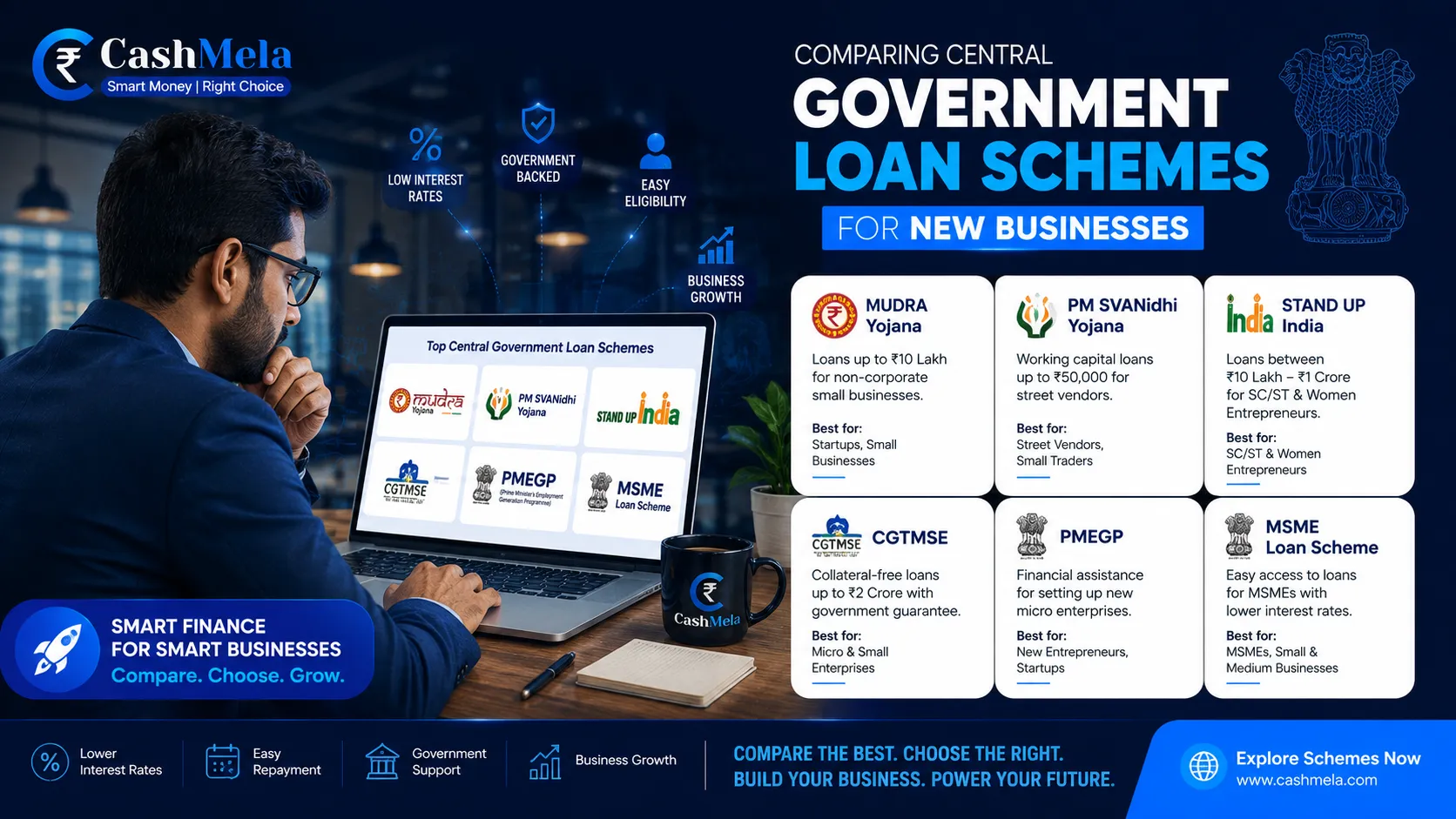
Among every business loan by government option available today, PMEGP stands out for entirely new manufacturing or service units, not expansions of an existing business. It comes with a direct capital subsidy of 15 to 35 percent depending on your category and location, with the rest financed through a bank loan. Manufacturing projects can go up to ₹ 50 lakh, service units up to ₹ 20 lakh.
Take Sunita's story as an example. A first-time entrepreneur in Lucknow, she used PMEGP to set up a small packaged snacks unit, applying directly through the KVIC portal before being routed to a partner bank. The subsidy meaningfully lowered her effective interest cost, something a standard bank loan alone never would have offered her.
Stand-Up India: Built for Women and SC/ST Entrepreneurs
This scheme mandates that every scheduled commercial bank branch sanctions at least one loan between ₹ 10 lakh and ₹ 1 crore to a woman borrower, and one to an SC or ST borrower, specifically for new "greenfield" enterprises. It's a composite loan, covering both term financing and working capital together in one package.
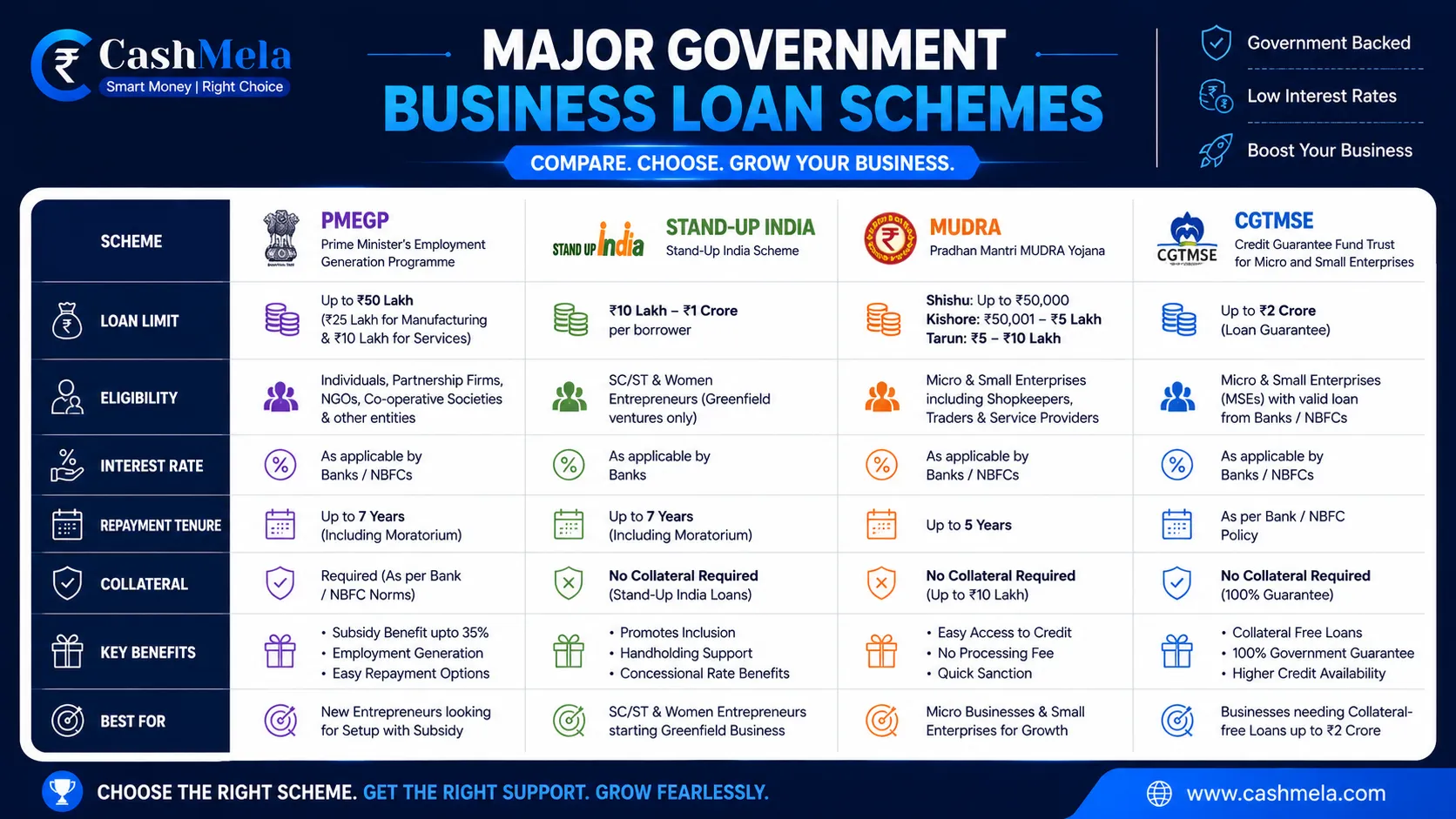
Comparing the Major Schemes
| Scheme | Best For | Loan Range | Key Benefit |
|---|---|---|---|
| PMEGP | New ventures | Up to ₹ 50 lakh | 15-35% capital subsidy |
| Stand-Up India | Women, SC/ST entrepreneurs | ₹ 10 lakh to ₹ 1 crore | Composite term + working capital loan |
| MUDRA | Micro and small businesses | Up to ₹ 10 lakh | No collateral required |
| CGTMSE-backed | Growing MSMEs | Up to ₹ 5 crore | Collateral-free credit guarantee |
How to Actually Apply for a Business Loan by Government Schemes
Is the process complicated? Somewhat, but far less than most people assume once you understand the basic sequence.
The General Application Flow
- Complete your Udyam Registration first, it's free and takes roughly 15 minutes online
- Identify which scheme fits your business stage, new venture versus existing operation matters here
- For PMEGP specifically, apply through the KVIC portal before being routed to a bank
- For most other schemes, approach a participating bank or NBFC directly with your documentation
Skipping that first step causes more headaches than people expect. Almost every single scheme treats Udyam Registration as non-negotiable, and showing up without it is quietly one of the most frequent, entirely preventable reasons applications get stuck right out of the gate.

What Actually Slows Down a Business Loan by Government Application
A few recurring habits trip up otherwise qualified applicants seeking a business loan by government channels. Missing Udyam Registration tops the list, followed closely by incomplete project reports for subsidy-linked schemes like PMEGP, which require considerably more documentation than a standard loan. Applying for PMEGP while already holding a MUDRA loan is another quiet disqualifier many people don't realize until it's too late.
Patience matters too. Subsidy-linked schemes genuinely take longer, PMEGP and Stand-Up India applications often run three to six weeks due to training modules and project assessments, while straightforward MUDRA loans can clear in a week or two.
Frequently Asked Questions
Q1: Can I apply for more than one government scheme at the same time?
A: Generally yes, as long as each loan serves a distinct business purpose and you separately meet eligibility for each. Some schemes, like PM Vishwakarma, explicitly exclude applicants already holding a PMEGP or MUDRA loan though.
Q2: Is collateral ever required under these schemes?
A: Most are collateral-free by design, particularly MUDRA and CGTMSE-backed loans. Larger amounts under Stand-Up India may involve some security requirements depending on the specific bank's internal policy.
Q3: How is PMEGP different from a standard MUDRA loan?
A: PMEGP is exclusively for brand-new enterprises and includes a direct capital subsidy, while MUDRA covers both new and existing micro-businesses without any subsidy component attached.
Q4: What credit score do I need for a government-backed business loan?
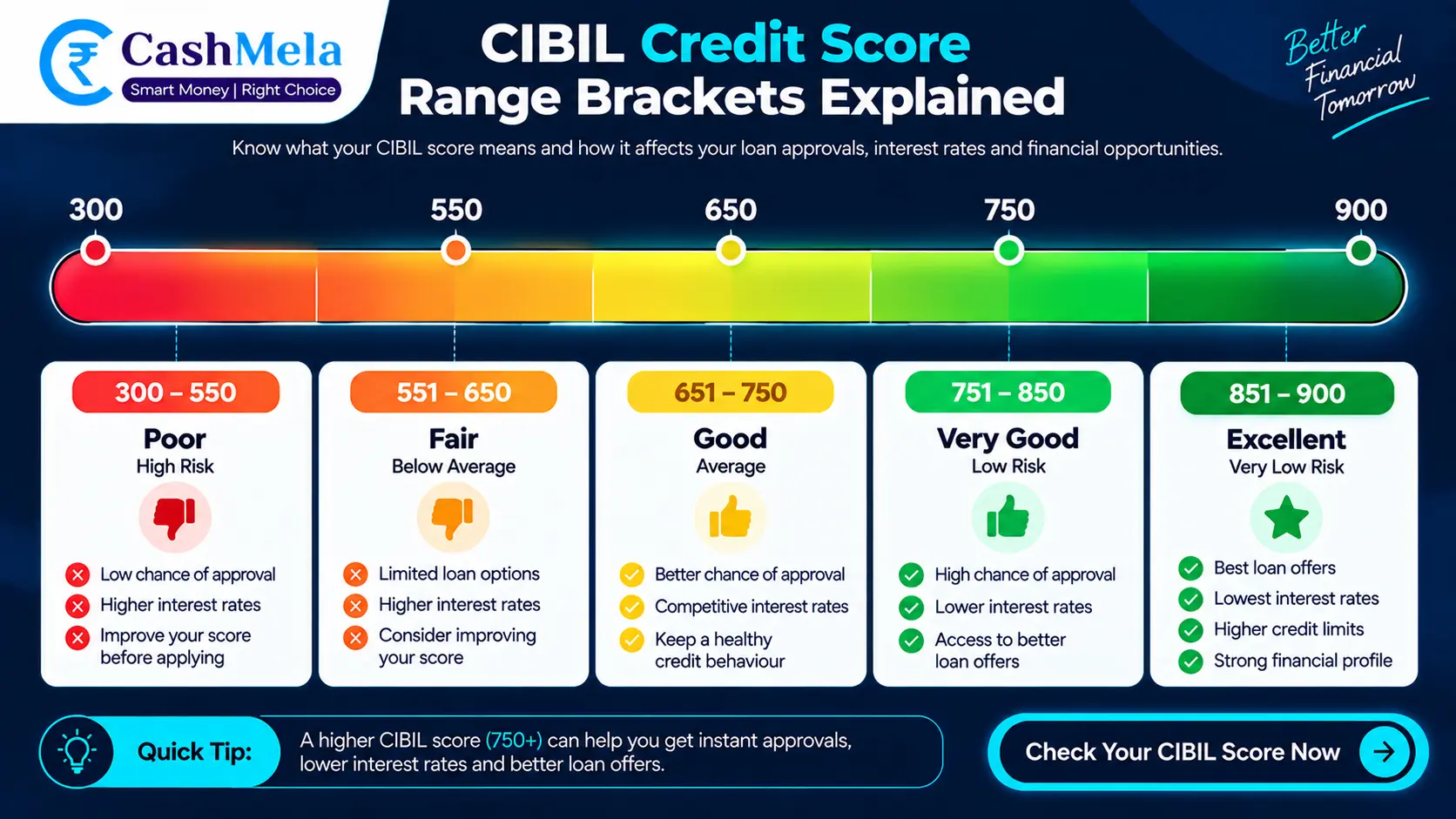
A: Requirements vary by scheme, but a score above 650 generally smooths approval. First-time entrepreneurs with no credit history can still qualify for MUDRA Shishu or PMEGP, since these focus more on project viability.
Q5: How long does a business loan by government schemes usually take to process?
A: MUDRA and similar straightforward schemes typically clear in one to two weeks. Subsidy-linked programs like PMEGP and Stand-Up India take longer, often three to six weeks, due to additional assessment steps.
Conclusion
Choosing the right business loan by government schemes comes down to matching your business stage and background to the scheme actually designed for it, rather than applying wherever seems fastest. Get your Udyam Registration sorted first, be honest about whether you're starting fresh or expanding, and give subsidy-linked applications the extra time they genuinely require. The support genuinely exists, it just takes a bit of homework to find the right door to knock on.
Ready to explore your options? Check your eligibility and apply now to find the government-backed loan that fits your business.
Stay Informed, Stay Ahead!
Follow Cashmela on social media for more practical finance guides, loan tips, and the latest updates: 💰 Instagram: @cashmela_com – Simple finance tips and real borrower stories 👍 Facebook: Cashmela – Join the conversation and never miss an update 🐦 X: @cash_mela – Quick updates and finance news 💼 LinkedIn: Cashmela – Industry insights and company updates ✨ Let's make smarter borrowing simple, together!

Adil Patel
Founder & Chief Executive OfficerAuthor & Financial Analyst at CashMela.com
Adil Patel is the Founder of Cashmela.com. With over a decade of deep domain expertise across Indian banking, debt restructuring, and digital lending, Adil established Cashmela to liberate Indian borrowers from predatory credit card interest traps and opaque multi-EMI debt burdens. Under his leadership, Cashmela has helped over 50,000 borrowers consolidate EMIs into single, transparent, and affordable repayment plans.