Introduction
If you've been running a business for a while, there comes a point where personal savings simply aren't enough to keep up with what the opportunity demands. A business loan is often the most practical bridge between where your company is today and where you actually want to take it. Whether it's buying new equipment, hiring a bigger team, expanding to a second location, or just smoothing out a rough cash flow month, the right business loan can make the difference between stalling and scaling.
This guide walks through what shapes your eligibility, what lenders actually look at, and how to avoid the most common mistakes people make before signing.

What a Business Loan Actually Covers
A lot of first-time applicants are surprised by how broad the definition of a business loan actually is. It's not just for buying machinery or opening a new branch. Lenders across India now offer business loans for a wide range of purposes, and most don't require you to specify exactly what the money is for beyond a general category.
- Working capital is probably the most common use. If your business runs on seasonal demand or faces payment delays from clients, a business loan can keep operations running smoothly without you having to dip into personal funds or delay salaries.
- Equipment and infrastructure purchases are another major category. If your production capacity is limited by outdated machinery, or your team is working out of a space that's simply too small, a business loan gives you access to capital without diluting equity or waiting months for a larger funding round.
- Inventory financing, vendor payments, marketing campaigns, technology upgrades, and even hiring costs all qualify under most lenders' definitions of legitimate business loan usage.
The key thing to understand is that this is a versatile product, not a narrow one.
Who Qualifies for a Business Loan
This is where a lot of applicants run into friction, not because they're unqualified, but because they didn't prepare the right way. Here's what most lenders in India look at when evaluating a business loan application.
For Self-Employed Individuals and Business Owners
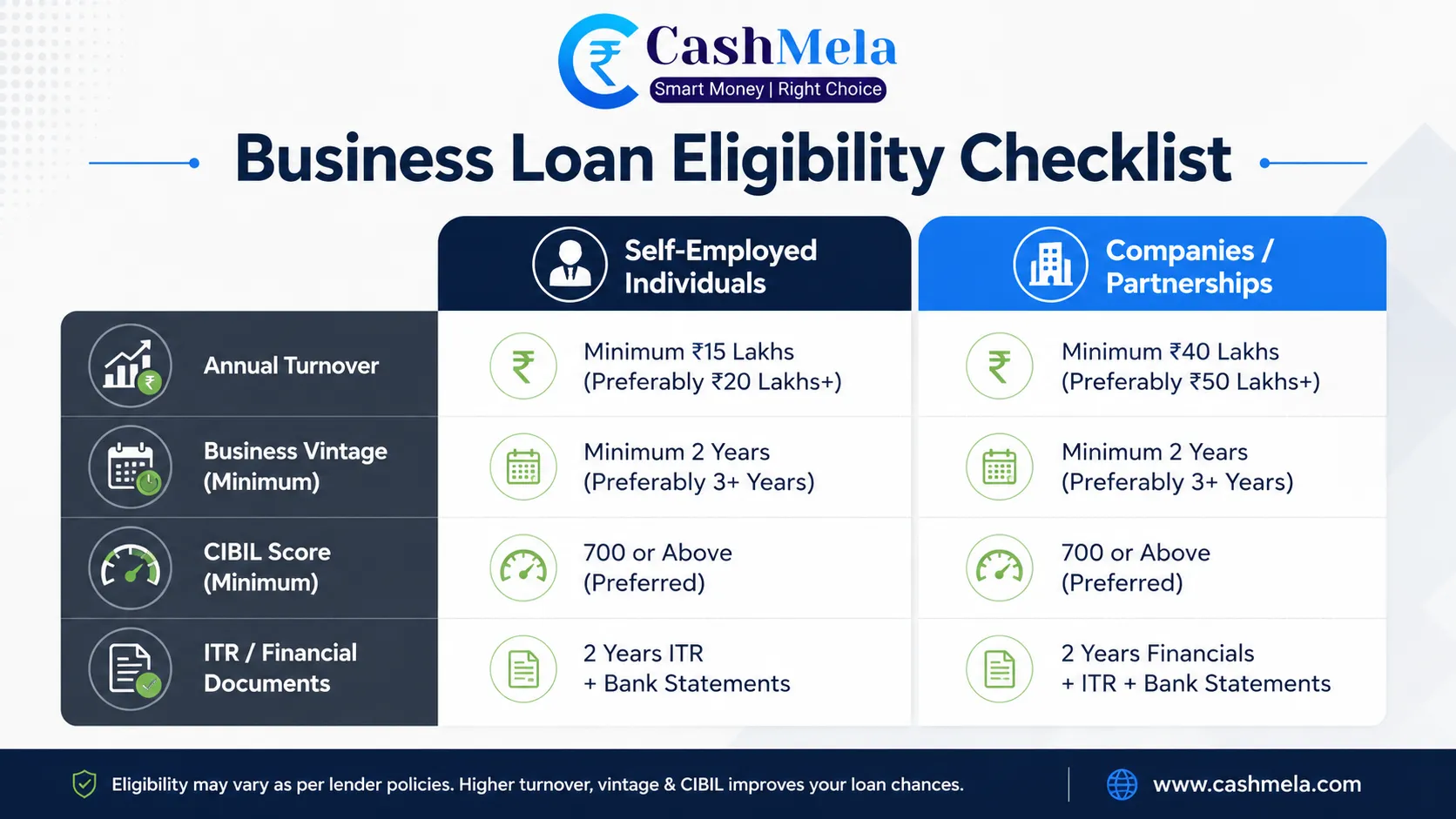
- Age typically between 21 and 65 years
- Business vintage of at least two to three years, depending on the lender
- Minimum annual turnover, which varies but often starts around Rs 10 lakh for unsecured products
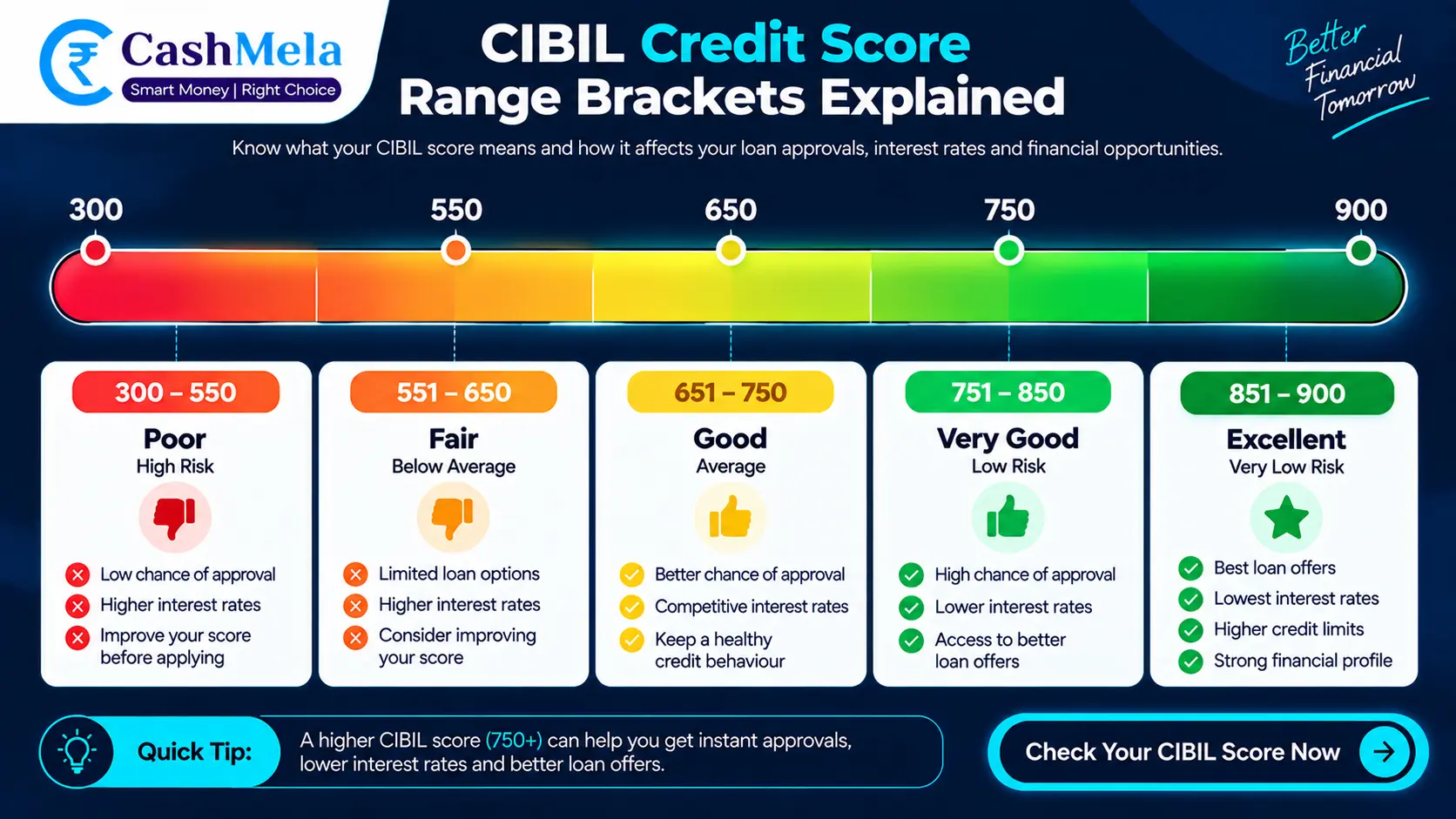
- A CIBIL score of 700 or above, with better scores unlocking better rates
- ITR filing for the last two years is almost always required
For Partnerships and Private Limited Companies
- Business registration proof and GST filing history
- Audited financials for the last two years
- Director or partner KYC documents
- Bank statements for the last twelve months showing healthy average balances and consistent inflows
Priya, a catering business owner in Pune, learned this the hard way. She'd been operating for four years with solid orders and a good reputation locally, but when she first applied for a business loan, she got rejected. The reason? Her ITR showed a much lower income than what actually flowed through the business, because her chartered accountant had optimised aggressively for tax savings. The bank saw low declared income and passed. She spent the next year working with her CA to show more realistic numbers, reapplied, and got approved without any issues. The lesson is a fairly common one: what looks smart from a tax angle can work against you when you need credit.
Documents You Need to Have Ready
Nobody enjoys hunting for paperwork at the last minute, so having this list sorted before you start the application saves a lot of back-and-forth.
For sole proprietors and self-employed applicants:
- PAN card and Aadhaar card
- Business registration certificate or GST registration
- Last two years' ITR with profit and loss statement
- Bank statements for the last six to twelve months
- Address proof for the business premises
For companies and partnerships, add:
- Certificate of incorporation or partnership deed
- Memorandum and articles of association
- Latest audited balance sheet
- GST returns for the last six to twelve months
- KYC documents for all directors or partners
The documentation requirement for a business loan is heavier than for a personal loan, which is why preparing in advance matters. Lenders need to build a picture of your business's financial health, not just your personal credit history. The cleaner and more consistent that picture looks across all your documents, the faster and smoother the process tends to be.
How to Get a Better Rate on Your Business Loan
Getting approved is the first goal. Getting a rate that doesn't eat into your margins is the second, and often the more important one.
- Maintain a strong CIBIL score. For business loans, lenders look at both your personal CIBIL score and, where applicable, your company's credit history. A personal score above 750 consistently puts you in a better position for pricing negotiations.
- Show healthy bank balances. Average monthly balance and the regularity of inflows in your business account tell a lender a lot about the actual health of your operations. Inconsistent deposits or a pattern of low balances close to month-end can trigger concerns even if your declared turnover looks fine.
- Don't apply to multiple lenders simultaneously. Every lender application triggers a hard inquiry on your credit report. If you apply to five lenders in the same week, each of them can see the others' inquiries, which raises a red flag about desperation or financial stress. Use a comparison platform like CashMela to check indicative offers across 40 plus lenders without triggering hard pulls, then apply to one or two that actually fit your profile.
- Keep your GST returns consistent with your bank statements. Lenders cross-check these regularly. A mismatch between declared GST turnover and actual bank inflows creates questions you don't want to spend time answering during underwriting.
Is there a shortcut to getting a lower rate? Not really. But the combination of a clean credit record, consistent financials, and a well-prepared application does more for your rate than any single tip.
Business Loan vs. Other Financing Options: What Actually Makes Sense
A business loan isn't the only way to fund growth, and it isn't always the right one. It's worth spending a moment comparing it against the alternatives before committing.
- An overdraft facility gives you a credit limit you can draw from as needed and pay interest only on what you use. For businesses with unpredictable cash flow, this is often more cost-effective than a term business loan where interest accrues on the full amount from day one.
- Invoice discounting or factoring works well if your business is sitting on a large amount of unpaid invoices. Instead of waiting 60 or 90 days for a client to pay, you sell the invoice to a financier at a small discount and get the cash immediately. No formal business loan required.
- Equity funding through angel investors or venture capital makes sense if you're scaling rapidly and the dilution is worth the capital infusion. But for most small and medium businesses, giving away equity for working capital is generally not the smartest move when a business loan at a reasonable rate is accessible.
The honest answer is that a term business loan works best when you have a specific, well-defined use for the capital, a clear repayment plan, and a business that generates consistent enough income to service the EMI without strain.

Frequently Asked Questions
Q1: What is the minimum turnover required for a business loan?
This varies significantly by lender and product. For unsecured business loans, minimum annual turnover requirements typically start around Rs 10 lakh, though some lenders go lower for micro-enterprise products. Secured business loans generally have more flexible income requirements since the asset provides the lender's security.
Q2: How long does it take to get a business loan disbursed?
For fully digital lenders and applicants with complete documentation, disbursal can happen within 48 to 72 hours of approval. Traditional banks often take longer, anywhere from a week to several weeks, depending on the loan size and the documentation review process.
Q3: Can a startup apply for a business loan?
Most unsecured business loans require a minimum business vintage of two to three years, which makes them inaccessible for very early-stage startups. Government-backed schemes like MUDRA loans or CGTMSE-covered products have more flexible terms for newer businesses and are worth exploring if your venture is under two years old.
Q4: Does a business loan affect my personal credit score?
For sole proprietors and self-employed individuals, yes, since the loan is typically taken in your personal capacity. For private limited companies, the loan is in the company's name, but lenders often require a personal guarantee from directors, which means a default can still impact your personal CIBIL score.
Q5: What happens if I miss a business loan EMI?
Missing even one EMI triggers a late payment mark on your credit report, which can stay for up to seven years. It also often triggers a penalty interest charge and can affect your relationship with the lender for future credit. If you anticipate a cash flow crunch, contact your lender before missing the payment. Most lenders have restructuring options that are far less damaging than a default.
Q6: Can I get a business loan without collateral?
Yes. Most major private banks and NBFCs in India now offer unsecured business loans up to Rs 50 lakh or more without requiring property or assets as security. Your creditworthiness, business financials, and banking history are the primary factors. Secured business loans go higher in amount but require collateral.
Q7: Is it better to take a business loan from a bank or an NBFC?
Banks generally offer lower interest rates but come with stricter eligibility and longer processing times. NBFCs are more flexible on eligibility, faster to disburse, but usually charge slightly higher rates. The right choice depends on your urgency, your eligibility, and how much the rate difference actually matters over your repayment period.
Conclusion
Taking a business loan is a meaningful financial decision, and like most meaningful decisions, it rewards people who go in prepared. Know your numbers, have your documents ready, understand what the full cost looks like across your chosen tenure, and compare across multiple lenders before committing to any one offer.
The right business loan, used for the right purpose, doesn't just solve an immediate problem. It creates space for your business to do things it couldn't do before.
Ready to find out what you'd actually qualify for? Check your eligibility and apply now to get a personalised business loan offer in minutes, or use CashMela's free EMI calculator to compare options across 40 plus lenders without affecting your credit score.
Internal Links
Follow CashMela on Social Media
Follow Cashmela on social media for more practical finance guides, loan tips, and the latest updates:
- Instagram: @cashmela_com – Simple finance tips and real borrower stories
- Facebook: Cashmela – Join the conversation and never miss an update
- X (Twitter): @cash_mela – Quick updates and finance news
- LinkedIn: Cashmela – Industry insights and company updates
Let's make smarter borrowing simple, together!
Disclaimer: Interest rates, eligibility criteria, and loan terms mentioned in this article are indicative and subject to change. Please verify the latest information with your chosen lender before making any financial decision. This article is for informational purposes only and does not constitute financial advice.

Adil Patel
Founder & Chief Executive OfficerAuthor & Financial Analyst at CashMela.com
Adil Patel is the Founder of Cashmela.com. With over a decade of deep domain expertise across Indian banking, debt restructuring, and digital lending, Adil established Cashmela to liberate Indian borrowers from predatory credit card interest traps and opaque multi-EMI debt burdens. Under his leadership, Cashmela has helped over 50,000 borrowers consolidate EMIs into single, transparent, and affordable repayment plans.