Introduction
Fatima's brother was admitted to a hospital in Lucknow with a severe lung infection. The pulmonologist recommended immediate treatment, the hospital wanted ₹ 85,000 before they would proceed, and Fatima had roughly forty minutes before the window closed.
She had no idea how to get medical emergency loan funds that fast. A quick search on her phone, a soft eligibility check on a comparison platform, a six-minute application, and an Aadhaar OTP later, she had approval in hand. The transfer cleared into her account within three hours.
Knowing how to get medical emergency loan funds quickly—and having that knowledge before a crisis hits—is what this guide is for.
What You Are Actually Borrowing When You Ask How to Get Medical Emergency Loan
Stripping it back to basics: a medical emergency loan is an unsecured personal loan. Nothing exotic, nothing complicated. A lender puts money into your account, you pay it back month by month with interest, and when the last payment clears, the obligation ends.
What separates it from a regular personal loan is the ecosystem built around it:
- Digital Underwriting: Proprietary algorithmic assessment that approves profiles in minutes rather than days.
- Aadhaar-based Identity Verification (e-KYC): Completely eliminates physical branch queues and paper document couriers.
- Specialized Lending Networks: Partner banks and NBFCs optimized for rapid NEFT/IMPS disbursement directly to your account.
The conventional path to a personal loan—paperwork at a branch, a relationship manager call, a week of waiting—does not work when a hospital billing desk wants a deposit in two hours. How to get medical emergency loan funds that actually arrive in time is a question about finding the right part of the lending ecosystem, not just the right lender.
| Core Feature | What to Expect from Emergency Medical Loans |
|---|---|
| Sanctioned Amount | ₹ 50,000 to ₹ 25 Lakh |
| Repayment Window | 12 to 60 Months (1 to 5 Years) |
| Starting Interest Rates | From ~10.5% per annum (based on CIBIL profile) |
| Disbursal Speed | 2 to 4 Hours on digital platforms (Minutes for pre-approved bank customers) |
| Collateral / Security | Zero (Completely Unsecured) |
| End-Use Flexibility | 100% unrestricted (Surgeon fees, ICU, medicines, travel, post-op care) |
How to Get Medical Emergency Loan Approval: Eligibility You Need to Meet
Running an eligibility check before submitting a formal application costs nothing and prevents the credit score damage that comes from applying to lenders whose thresholds you don't reach. The criteria across most lenders break down like this:
1. If You Receive a Monthly Salary
- Age: 23 to 58 years at most lenders.
- Take-Home Pay: Minimum ₹ 20,000 per month at the lower end; ₹ 25,000 for top-tier private banks and metro-focused NBFCs.
- Employment History: At least 6 months at your current job, with 1 full year of total work experience preferred.
- Credit Score: A CIBIL score of 700 and above opens bank products cleanly; 650 and above reaches most NBFC and digital fintech platforms.
2. If You Run Your Own Business (Self-Employed)
- Age: 25 to 65 years.
- Declared Annual Income: ₹ 3 lakh and above as a general floor, though individual lenders set their own criteria.
- Business Track Record: At least 2 years of active business operations.
- Documentation: 2 years of filed Income Tax Returns (ITR) alongside 12 months of business bank statements.
Insider Tip: The fastest approvals consistently go to salaried applicants with a strong CIBIL score who already hold accounts with the lending bank. If that describes you, check your bank's mobile app first for a pre-approved personal loan offer. Pre-approved amounts often disburse within minutes because the bank already has your complete financial KYC and transaction history.
Eligibility Comparison: Salaried vs. Self-Employed
| Requirement | Salaried Applicants | Self-Employed Applicants |
|---|---|---|
| Minimum Age | 23 Years | 25 Years |
| Maximum Age | 58 Years | 65 Years |
| Income Threshold | ₹ 20,000 to ₹ 25,000 / month | ₹ 3,00,000+ annual business turnover |
| Minimum CIBIL Score | 650 (NBFCs) / 700 (Banks) | 650 (NBFCs) / 700 (Banks) |
| Work / Vintage Track | 6 months current / 1 yr total | 2+ years verified active operations |
| Primary Proofs | PAN, Aadhaar, 3 Salary Slips, 6 Mo Bank Stmt | PAN, Aadhaar, 2 Yrs ITR, 12 Mo Bank Stmt |
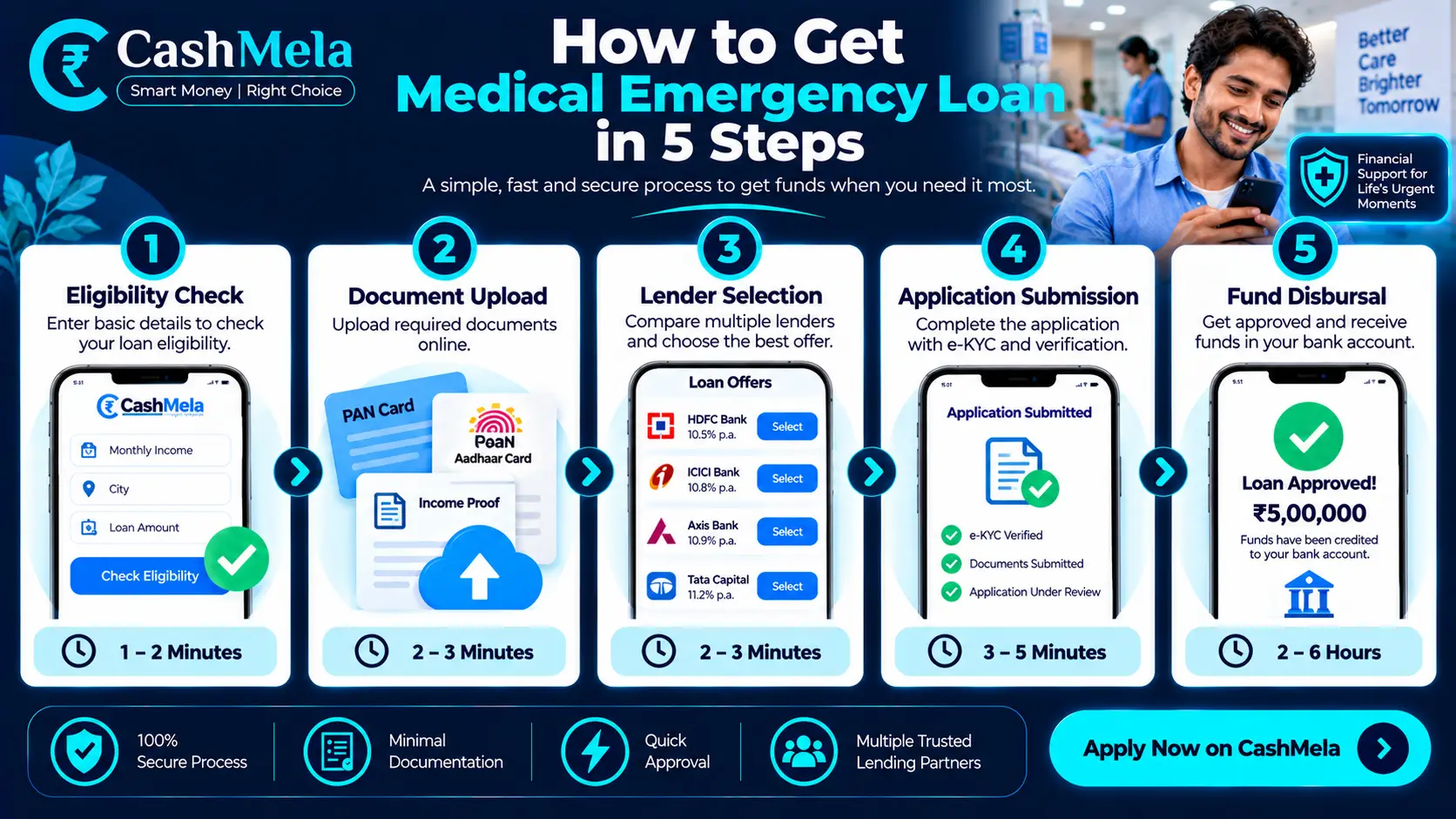
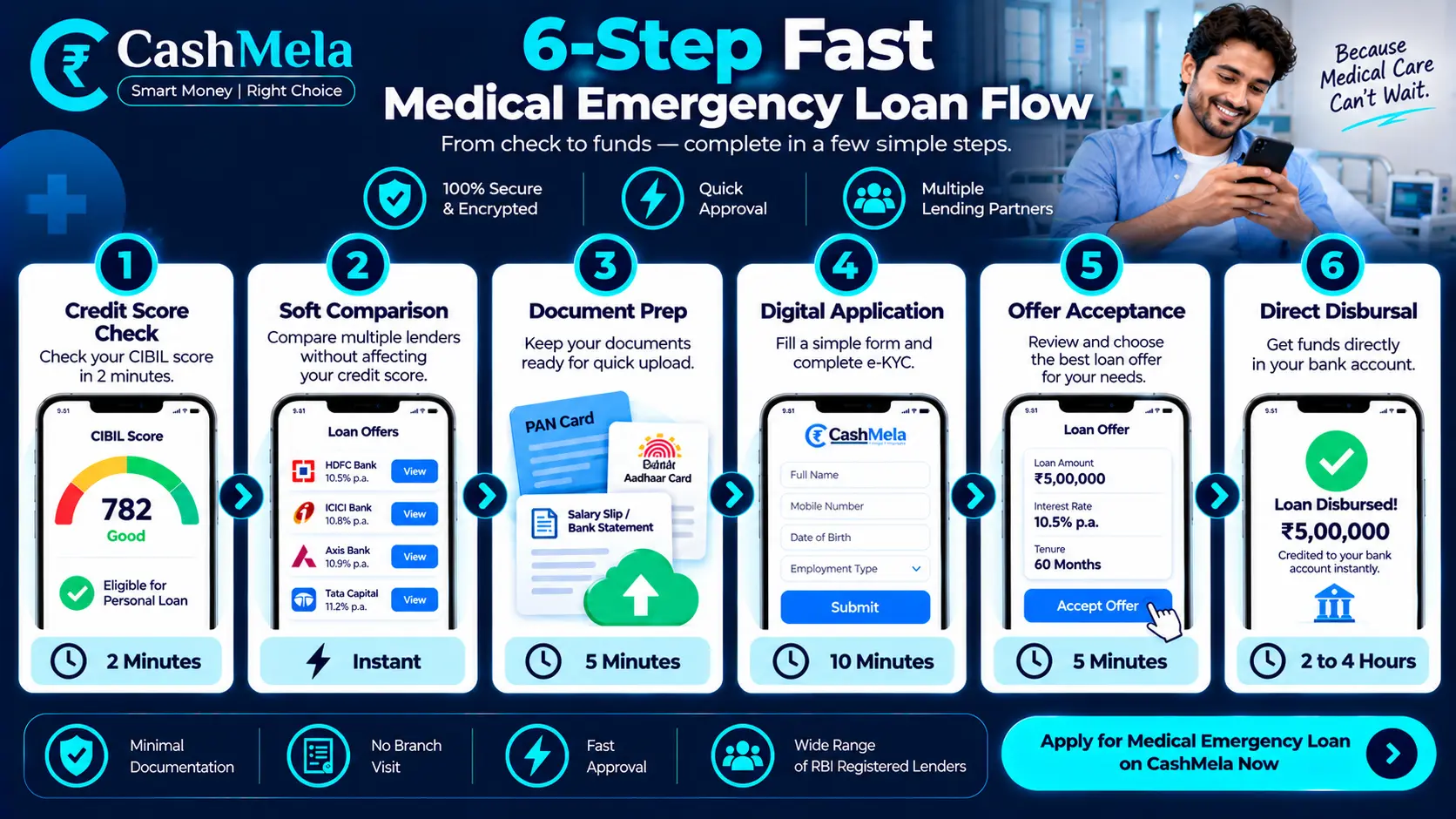
How to Get Medical Emergency Loan Approved Quickly: The Step-by-Step Process
This is the section worth reading before a crisis arrives. Each step here makes the actual application faster when the situation demands it.
Step One: Check Your CIBIL Score
Your credit score determines which lenders will engage with you and at what interest rate. A score above 750 opens most doors at competitive rates. Between 650 and 749, NBFC and fintech lenders remain accessible. Knowing your score before you apply means you go to the right lender the first time, rather than accumulating hard inquiries from lenders whose minimum threshold you don't meet.
CashMela offers a free CIBIL credit score check with no impact on your score. Run it first. It takes about two minutes and shapes every decision that follows.
Step Two: Run Soft Checks Before Any Formal Application Goes Anywhere
This is where most borrowers make the mistake that costs them points on their credit score at exactly the wrong moment. Submitting formal applications to four or five lenders in a single afternoon feels like increasing your chances. What it actually does is fire off four or five hard inquiries simultaneously, each one visible to subsequent lenders, each one nudging your score downward.
Figuring out how to get medical emergency loan approval without that damage means using a comparison platform first. CashMela shows you indicative offers from 40+ lenders based on a soft check that reports nothing to any bureau. Once you know which one or two lenders match your profile, apply only to those.
Step Three: Sort Your Documents Before the Application Opens
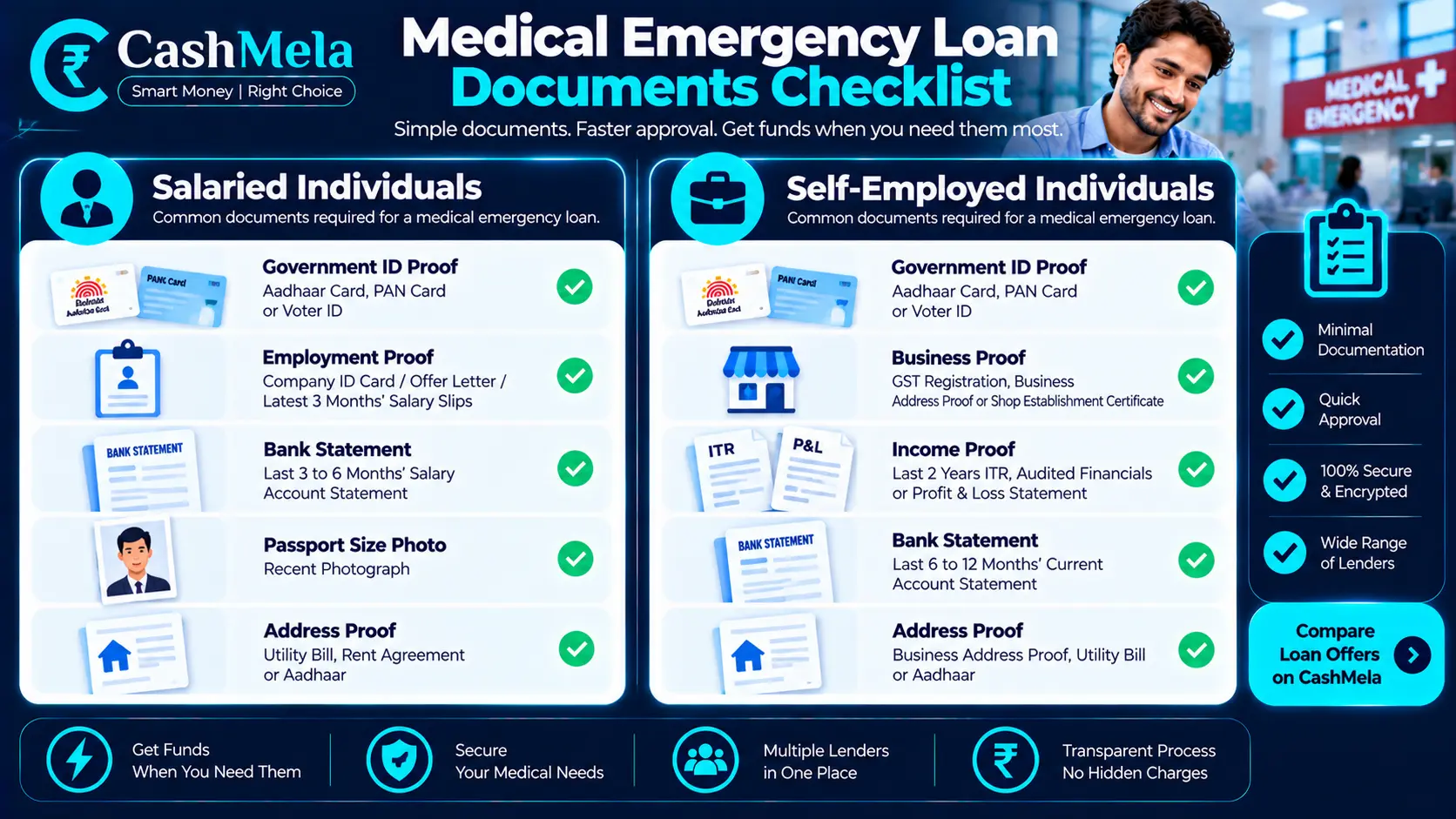
The fastest medical emergency loan applications belong to people who already have everything photographed and filed in a secure folder on their smartphone:
- Clear photos of your PAN card and Aadhaar card.
- Last 2 to 3 recent salary slips if you're salaried.
- 6 months of bank statements reflecting your salary credits.
- For self-employed applicants: 12 months of business account statements plus the most recent ITR.
A growing number of platforms now connect to the Account Aggregator (AA) network. Where that integration exists, your bank statements flow through securely with a single consent tap on your phone, and manual PDF uploads vanish from the process entirely.
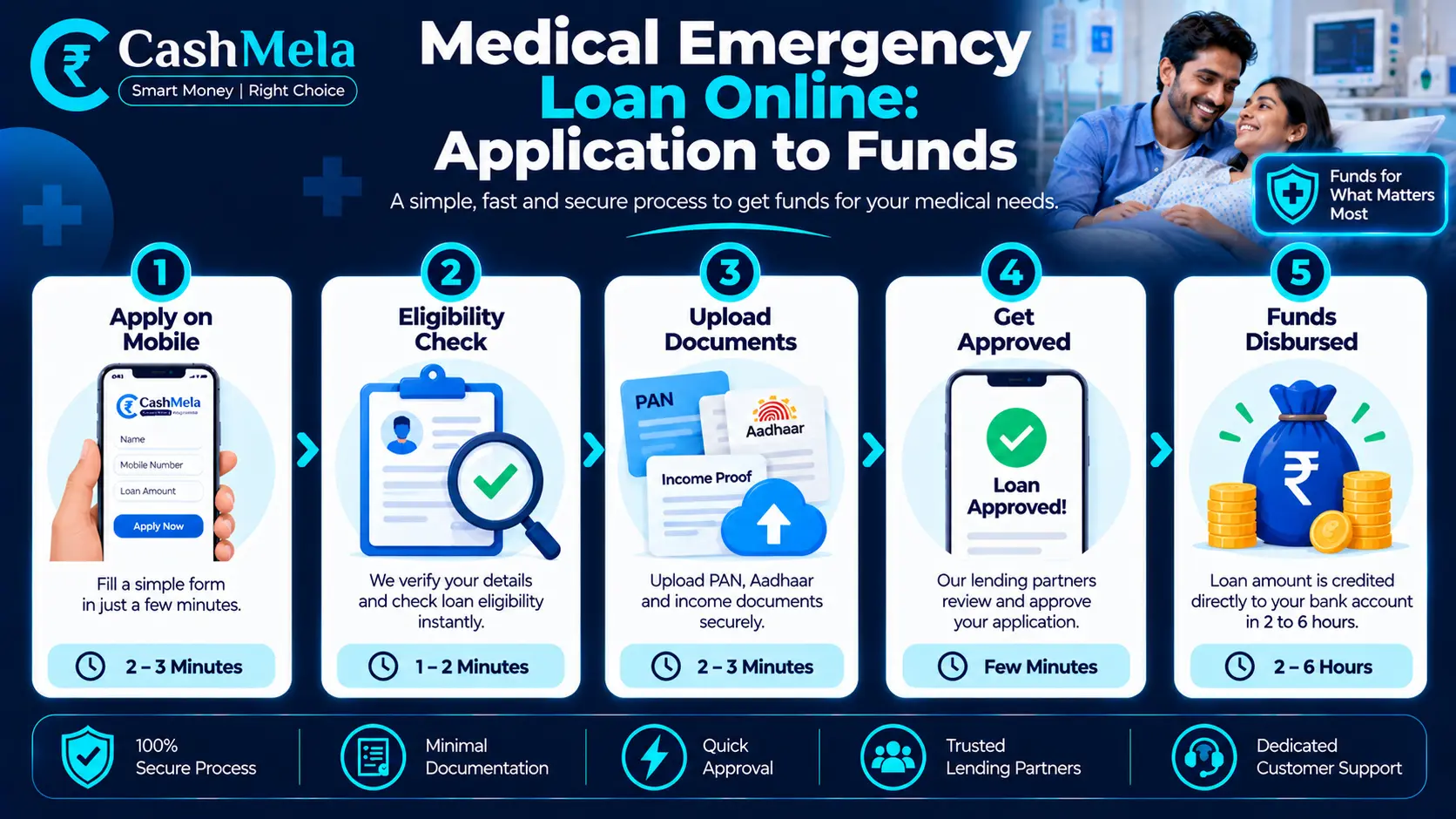
Step Four: Complete the Digital Application
Most lenders handling medical emergency loans now run the entire process through a mobile app or web interface. The form captures personal details, employment information, income, and the exact loan amount you need. Aadhaar OTP verification handles identity confirmation without any physical paperwork. The complete application usually takes between 8 and 15 minutes.
Step Five: Review the Offer and Accept
When the lender presents a formal offer, look beyond the headline interest rate:
- Check the Processing Fee: Usually 1% to 3% + GST, deducted from your loan payout.
- Calculate Net Disbursal: Ensure the net cash hitting your bank account satisfies your hospital's immediate deposit requirement.
- Verify the EMI: Match the monthly installment against your household budget across the recovery period. If your income may dip during a family member's prolonged recovery, a slightly longer tenure with a lower EMI might be the safer choice, even if it costs slightly more in total interest.
Step Six: Track the Transfer
After digital acceptance of the sanction letter, the transfer initiates via IMPS or NEFT. Open your bank's mobile app or UPI account summary screen rather than waiting for an SMS notification. Credits show up in your live account balance before carrier push notifications catch up.
How to Get Medical Emergency Loan with a Low CIBIL Score
A low credit score complicates the borrowing process, but it does not end it. Here is how real borrowers navigate it successfully:
Real Borrower Case Study: Rajan's Story
Rajan, a delivery fleet owner in Bhopal, had a CIBIL score of 648 when his father was hospitalized with an acute kidney condition. His score was low because of an overdue credit card balance from two years earlier. He assumed no bank would touch his profile.
He ran a soft check on CashMela and found two NBFCs willing to lend based on his steady business account cash flows. The interest rate was slightly higher than what a 750-score borrower would receive, but the loan covered the entire hospitalisation deposit. Rajan repaid the loan responsibly over eighteen months, and his credit score climbed back to 702 by the time the account was closed.
For borrowers with credit scores below 700, here are proven tactics that work:
- Target NBFCs and Digital Lenders: Non-banking financial companies evaluate holistic banking data and cash flows rather than adhering strictly to rigid bank score cut-offs.
- Apply for a Modest Amount: Asking for ₹ 1 lakh to ₹ 2 lakh rather than the maximum ₹ 10 lakh ceiling dramatically improves approval odds for lower credit scores.
- Add a Co-Applicant: Applying alongside a spouse, parent, or working sibling with a clean credit profile provides immediate underwriting reassurance.
- Consider Secured Options if Needed: If unsecured digital loans are unavailable, gold loans or loans against mutual funds/fixed deposits provide instant liquidity without credit score friction.
- Use Soft Comparison First: Never apply blindly to multiple lenders. Let comparison algorithms identify lenders whose minimum CIBIL threshold you already satisfy.
Common Mistakes People Make When Figuring Out How to Get Medical Emergency Loan
Neha applied to four different lenders in the same afternoon while her mother was in the ICU. All four ran hard inquiries. Her score dropped by 31 points across those three hours. The fourth lender, the one that finally approved her, offered a worse interest rate partly because of what the sudden cluster of recent inquiries signalled. She got the loan, but it cost her thousands more in interest than it needed to.
These are the common traps that produce costly situations like Neha's:
- Applying Simultaneously to Multiple Platforms: Soft checks are always available through comparison platforms. There is zero reason to submit formal applications to more than one or two lenders at a time.
- Accepting the First Offer Without Reading the Sanction Letter: Processing fees, foreclosure penalties, and EMI bounce charges are all laid out in the sanction letter. Two minutes of careful reading protects you from hidden surprises.
- Borrowing Only for the Immediate Bill: Hospital stays often have a second financial phase: post-discharge medications, physiotherapy, diagnostic follow-ups, and specialist visits. Borrowing slightly more than the initial deposit—within what you can comfortably service—prevents the need for a second loan later.
- Using Unverified Platforms During an Emergency: Legitimate platforms always display RBI registration details and partner NBFC names clearly. Any app or website asking for upfront "processing fees" transferred via personal UPI before disbursing funds is fraudulent.
Frequently Asked Questions
Q1: How to get medical emergency loan funds the same day?
Apply through a digital lending platform or NBFC app that features automated underwriting. Have your PAN, Aadhaar, and recent bank statements ready on your phone before you start. Complete the Aadhaar OTP-based e-KYC in the same session. For eligible applicants with complete documentation, same-day disbursal within 2 to 4 hours is standard practice.
Q2: How to get medical emergency loan without a salary slip?
Self-employed applicants can provide 12 months of bank statements alongside their most recent ITR. Many modern lenders also accept digital bank statement analysis via Account Aggregator for salaried individuals whose employers don't issue formal salary slips. Additionally, smaller ticket-size emergency loans are available from select fintechs based on your CIBIL profile and digital bank inflows.
Q3: What is the minimum CIBIL score required to get a medical emergency loan?
Most traditional banks require a score of 700 and above for personal loans. NBFCs and fintech lenders routinely approve applicants with scores between 650 and 699. Select specialized lenders work with profiles below 650 at adjusted interest rates. Checking your score through CashMela's free CIBIL tool tells you where you stand instantly.
Q4: Can I get a medical emergency loan for a family member's treatment?
Yes. The loan is issued in your name and you bear the repayment responsibility, but you are completely free to deploy the funds for any family member—parents, spouse, children, or siblings. Lenders place zero restrictions on which patient's medical bills the funds cover.
Q5: How much can I borrow through a medical emergency loan?
Most lending platforms provide loan amounts ranging from ₹ 50,000 up to ₹ 25 lakh. The final sanctioned limit is calculated as a multiple of your net monthly income after accounting for existing EMI obligations and credit history.
Q6: Does getting a medical emergency loan affect my credit score?
A soft eligibility check on a comparison platform has zero impact on your credit score. A formal loan application triggers a single hard credit inquiry resulting in a tiny, temporary dip. Once active, consistent and punctual EMI repayments will strengthen your repayment track record and elevate your CIBIL score over time.
Q7: What if I cannot repay a medical emergency loan EMI due to the illness affecting my income?
Contact your lender before the payment due date rather than missing it silently. Regulated banks and NBFCs offer restructuring plans, tenure extensions, or temporary moratorium periods for genuine medical emergencies. Missed payments result in late fees and negative bureau remarks that stay on your record for up to 7 years. A proactive conversation with your lender almost always produces a manageable solution.
Conclusion
A health crisis is not the moment to be researching how to get medical emergency loan funds for the first time. The families who navigate these situations with the least financial damage are consistently the ones who already knew which platforms to trust, had their documents accessible, and understood roughly what they would qualify for before anything happened.
The steps are straightforward once you know them:
- Check your CIBIL score.
- Use a comparison platform before applying anywhere formally.
- Keep digital copies of your documents ready on your phone.
- Choose a tenure and EMI that comfortably fits your household cash flow during and after the medical recovery.
That is how to get medical emergency loan approval fast and at a rate that doesn't compound the financial stress of an already challenging time.
Ready to check your eligibility right now? Apply free on CashMela and compare medical emergency loan offers from 40+ trusted lenders in minutes, with no impact on your CIBIL score.
Internal Links
- Compare Personal Loans from 40+ Lenders
- Medical Emergency Loan Guide
- Medical Emergency Loan Online Guide
- Medical Emergency Loan in India Guide
- Medical Emergency App Loan Guide
- Medical Emergency Loan App Free Guide
- Free CIBIL Credit Score Check
- Free EMI Calculator
Follow CashMela on Social Media
Follow Cashmela on social media for more practical finance guides, loan tips, and the latest updates:
- Instagram: @cashmela_com – Simple finance tips and real borrower stories
- Facebook: Cashmela – Join the conversation and never miss an update
- X (Twitter): @cash_mela – Quick updates and finance news
- LinkedIn: Cashmela – Industry insights and company updates
Let's make smarter borrowing simple, together!
Disclaimer: Loan terms, interest rates, and eligibility criteria mentioned in this article are indicative and subject to change. Please verify the latest information with your chosen lender before making any financial decision. This article is for informational purposes only and does not constitute financial or medical advice.

Samarth Shigvan
Marketing Head & Growth LeadAuthor & Financial Analyst at CashMela.com
Samarth Shigvan is the Marketing Head at Cashmela.com. He oversees brand strategy, performance marketing, SEO, and borrower educational initiatives across India. Samarth is passionate about simplifying complex financial topics—such as CIBIL score optimization, interest rates comparison, and debt freedom strategies—into actionable, transparent guides for everyday consumers.