Introduction
Sana was sitting outside an ICU in Hyderabad when the hospital billing desk asked for ₹ 70,000 within the hour. She found a lender online, filled the form in ten minutes, and then hit a wall.
Her PAN card showed “Sana Begum”, her Aadhaar said “Sana B.”, and the automated verification engine flagged a mismatch. Two crucial hours went into resolving a spelling discrepancy while doctors waited for clearance.
That is the thing about medical emergency loan documents: it is rarely the big papers that trip people up, it is the small, boring details. This guide walks you through exactly what you need, what you can skip, and how to keep everything ready before life forces your hand.
What Medical Emergency Loan Documents Do Lenders Actually Ask For?
Strip away the banking jargon, and lenders fundamentally want to verify three things: Who are you?, Can you repay?, and Where should the money go? Every paper on the checklist answers one of those questions.
A medical emergency loan is almost always an unsecured personal loan, which means the paperwork is significantly lighter than a home, gold, or business loan. Still, the exact medical emergency loan documents vary depending on your employer category, the loan quantum, and whether you apply through a bank or a digital NBFC.
The Core Document Checklist
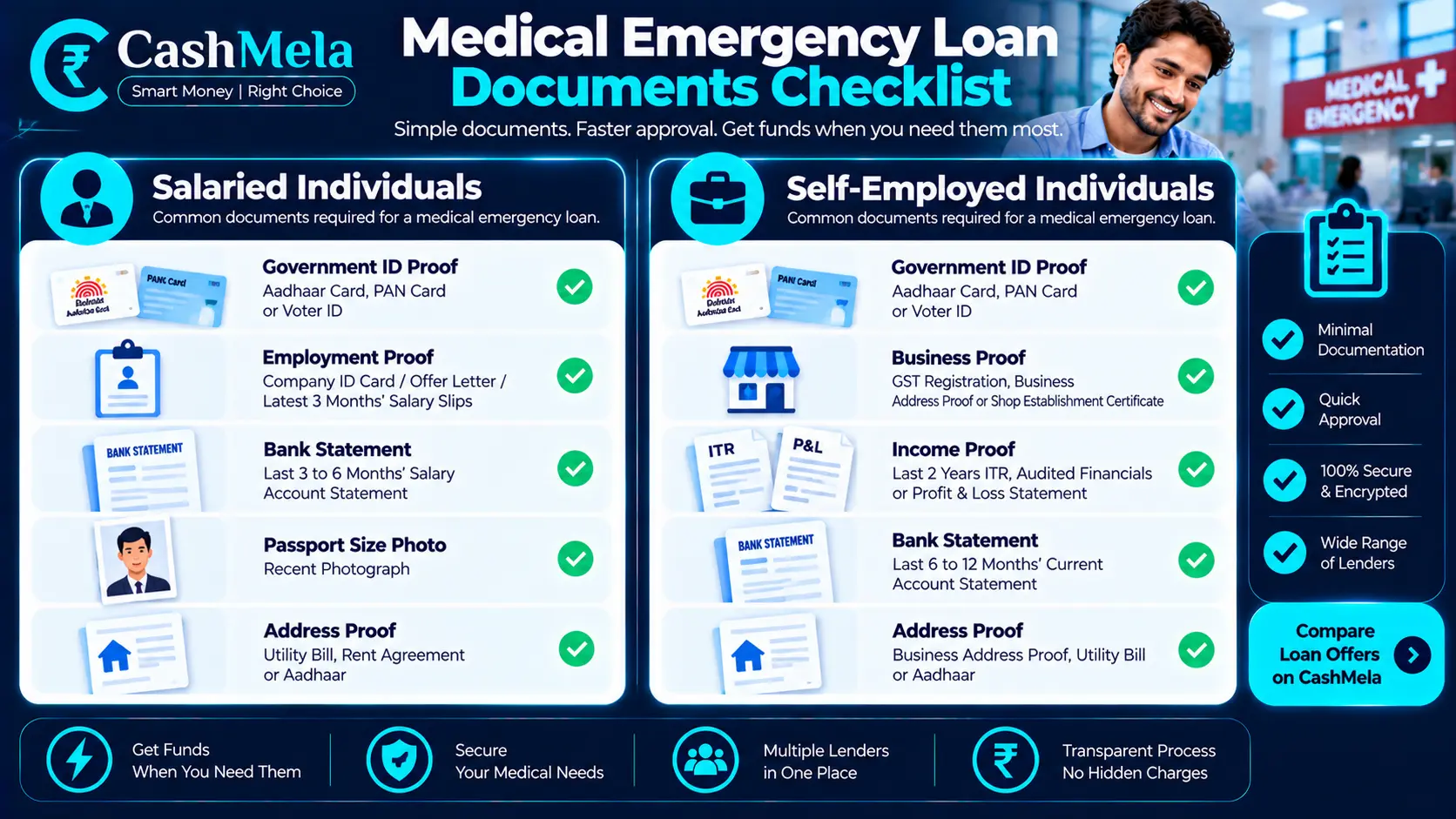
Almost every lender requires this baseline set:
- Identity Proof: PAN Card (mandatory for tax and credit bureau reporting) and Aadhaar Card.
- Address Proof: Aadhaar Card, Passport, Voter ID, or a recent utility bill (electricity, piped gas) in your name.
- Live Photograph: Captured in real-time through your smartphone camera during the digital application session.
- Income Proof: Recent salary slips or Income Tax Returns (ITR).
- Banking Record: Last 3 to 6 months of bank account statements reflecting income inflow.
Do You Need the Hospital Bill Too?
Most lenders do not insist on hospital bills or diagnostic sheets for a standard personal loan because the funds are disbursed directly into your bank account as unrestricted cash.
However, some medical-specific zero-cost EMI products or hospital-tied finance desks do require a doctor’s admission advice note or estimated bill. It is always wise to keep a photographed copy of the hospital's cost estimate on your phone just in case.
Medical Emergency Loan Documents for Salaried Borrowers
If you draw a predictable monthly salary, your paperwork is the fastest and easiest to process. Lenders view steady payroll credits as strong reassurance, allowing automated underwriting algorithms to approve applications in minutes.
What to Keep Ready on Your Phone:
- Latest 2 to 3 Months’ Salary Slips: Showing gross pay, net take-home, and statutory deductions like EPF/Professional Tax.
- 6 Months of Salary Bank Statements: Downloaded as clean PDFs directly from your mobile banking app.
- Employee ID Card or Official Email Verification: Some lenders send a quick OTP or verification link to your corporate email ID.
- Form 16 or Recent ITR (Optional): Helpful if you are applying for a high ticket loan above ₹ 10 lakh.
The Power of Clean Bank Statements: Think of your salary account statement as your financial report card. Regular monthly credits on the same calendar date, a healthy average quarterly balance, and zero inward cheque or auto-debit bounces tell the lender more than any application form can.
Medical Emergency Loan Documents for the Self-Employed
Running your own business, retail outlet, or consulting practice means a slightly more comprehensive folder, but it is far from difficult when planned in advance.
Real Borrower Experience: Anil’s Story
Anil owns a thriving hardware and electrical supply store in Indore. When his mother required an emergency cardiac procedure, the private hospital requested ₹ 1.5 lakh immediately.
As a business owner, Anil had no salary slips. However, he kept clean digital copies of his last two years of ITR, twelve months of current account statements, and his GST registration certificate. He uploaded them via a comparison platform, received approval from a partner NBFC within 45 minutes, and funds cleared by evening.
What Self-Employed Applicants Should Keep Ready:
- Last 2 Years of ITR: Along with computation of income sheets and acknowledgment receipts.
- 12 Months of Current/Savings Account Bank Statements: Demonstrating steady business receipts and cash turnover.
- Business Vintage Proof: GST registration certificate, Udyam MSME certificate, or municipal Shop & Establishment licence.
- Audited Financials (P&L and Balance Sheet): Only required for higher loan amounts exceeding ₹ 10 to ₹ 15 lakh.
Self-employed applicants should expect lenders to assess average quarterly cash balances rather than fixed monthly dates. Fluctuating seasonal revenue is completely acceptable as long as the historical average comfortably covers the prospective EMI.
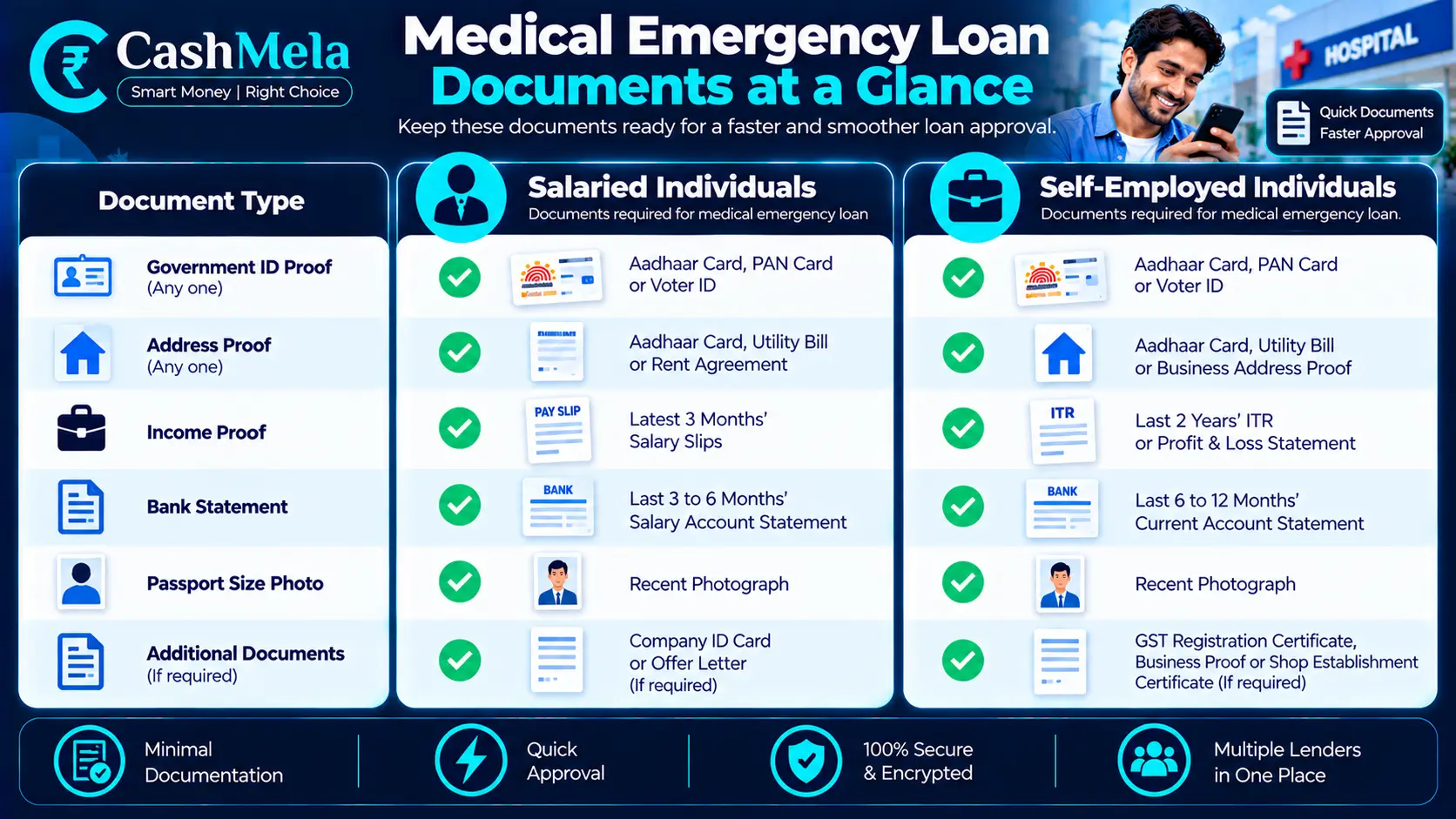
Medical Emergency Loan Documents: Salaried vs. Self-Employed Comparison
| Document | Salaried Applicants | Self-Employed Applicants | Why Lenders Require It |
|---|---|---|---|
| PAN Card | Required | Required | Primary tax identity & bureau pull |
| Aadhaar Card | Required | Required | Instant paperless e-KYC & address |
| Address Proof | Covered by Aadhaar | Covered by Aadhaar / Business Lease | Verifies current residence |
| Salary Slips | Required (2 to 3 months) | Not Applicable | Confirms current monthly take-home |
| Bank Statements | 3 to 6 Months | 12 Months | Demonstrates cash flow & spending habits |
| ITR Filing | Optional / Form 16 | Required (2 Years) | Authenticates reported annual earnings |
| Business Registration | Not Applicable | Required (GST / Udyam) | Confirms legal business existence |
| Hospital Estimate | Optional | Optional | Only for hospital-tied EMI schemes |
How to Get Your Medical Emergency Loan Documents Ready Before a Crisis
Nobody plans a medical emergency on their calendar. But dedicating 30 minutes on a quiet weekend can save you hours of panic in a hospital waiting room.
- Create a Dedicated Phone Folder: Name it "Loan Papers" on your phone or Google Drive/iCloud. Store high-resolution PDFs of your PAN, Aadhaar, salary slips, and recent bank statements.
- Reconcile Name Discrepancies: Verify that your name, initials, and date of birth match character-for-character across your PAN card, Aadhaar card, and bank account. Fix mismatches now at an Aadhaar Seva Kendra, not in an ICU billing queue.
- Keep Your Aadhaar Mobile Number Active: Digital e-KYC relies entirely on an Aadhaar-linked OTP. If your Aadhaar is linked to an old, inactive phone number, digital approvals are impossible.
- Download Password-Free Bank Statements: Many net banking apps generate password-protected PDFs (e.g., PAN + Date of Birth). Unlock the file before uploading or keep the password noted.
- Leverage Account Aggregator (AA) and DigiLocker: Leading platforms integrate directly with the RBI-regulated Account Aggregator network. With a single consent tap, verified bank statements sync automatically, eliminating manual file uploads.
- Check Your Credit Score: While not a physical document, your CIBIL score is the digital master key. Run a free CIBIL credit score check on CashMela to know which lenders will approve you instantly.
Document Mistakes That Slow Down Approval
Even diligent borrowers fall into simple document traps during stressful medical moments. Watch out for these six common pitfalls:
- Blurry or Cut-Off Photos: If the underwriter or OCR algorithm cannot read your PAN number or father's name clearly, the application is pushed to manual review. Photograph documents flat on a dark background in good lighting with all four corners visible.
- Outdated Pay Slips: Providing a pay slip from four months ago instead of the most recent month will trigger automated rejection.
- Mismatched Particulars: As illustrated in Sana’s case, even an abbreviated surname between PAN and Aadhaar can stall digital sanction.
- Password-Protected Bank PDFs: If an automated parser cannot open your uploaded statement due to an unprovided encryption password, your approval stalls.
- Forged or Edited Documents: Never use editing apps to alter pay figures or bank balances. Lenders cross-verify data directly with banking APIs and the income tax database; forged documents lead to permanent blacklisting on credit bureaus.
- Paying Upfront "Document Processing Fees": Legitimate lenders and NBFCs never ask you to pay advance fees via UPI or cash before approving an application. All legal charges are deducted transparently from the disbursed loan amount.
Frequently Asked Questions
Q1: What are the basic medical emergency loan documents I need?
At minimum, you need your PAN card, Aadhaar card (with mobile number linked for OTP verification), recent income proof (2-3 months of salary slips or 2 years of ITR), and 3 to 6 months of bank account statements.
Q2: Do I need hospital bills as part of my medical emergency loan documents?
Generally, no. For unsecured digital personal loans, lenders disburse cash directly into your bank account and place no restrictions on how it is deployed. Only specific medical EMI cards or hospital billing partnerships require an official cost estimate or doctor’s prescription.
Q3: Can I get a loan without salary slips?
Yes. Self-employed borrowers can qualify using 12 months of bank statements and filed ITRs. Salaried individuals who do not receive formal salary slips can often qualify if their bank statements show consistent monthly payroll deposits, or by applying through select fintech lenders that evaluate banking cash flow algorithms.
Q4: How long does document verification take?
When documents are clear and e-KYC is completed via Aadhaar OTP and Account Aggregator, algorithmic verification takes under 10 minutes. When scans are blurry, password-protected, or names mismatch, manual reviews can stretch verification to 24-48 hours.
Q5: Can I apply entirely online from my smartphone?
Yes. Modern digital lending platforms and comparison portals like CashMela facilitate end-to-end paperless processing on your smartphone—from soft comparison to Aadhaar e-KYC, camera document uploads, and e-mandate setup.
Q6: Does uploading medical emergency loan documents affect my credit score?
Uploading documents on a comparison platform for a soft eligibility check has zero impact on your credit score. Only when you formally submit an application to a specific lender does a single, standard hard inquiry occur.
Conclusion
Paperwork is not glamorous, but when a hospital clock is ticking, having your documents organized is the difference between immediate treatment clearance and agonizing delays.
Keep your PAN, Aadhaar, salary slips, and bank statements filed in one secure folder on your smartphone. Reconcile your names across all records today, and confirm your mobile number is actively linked to Aadhaar.
Get your medical emergency loan documents in order now, and any unexpected health crisis will cost you far less time, money, and emotional stress.
Ready to see which lenders match your profile today? Apply now on CashMela and compare medical emergency loan offers from 40+ trusted lenders in minutes, with zero impact on your credit score.
Internal Links
- Compare Personal Loans from 40+ Lenders
- Medical Emergency Loan Guide
- Medical Emergency Loan Online Guide
- How to Get Medical Emergency Loan
- Medical Emergency Loan SBI Guide
- Medical Emergency Loan in India Guide
- Free CIBIL Credit Score Check
- Free EMI Calculator
Follow CashMela on Social Media
Follow CashMela on social media for practical finance guides, loan tips, and the latest updates:
- Instagram: @cashmela_com – Simple finance tips and real borrower stories
- Facebook: Cashmela – Join the conversation and never miss an update
- X (Twitter): @cash_mela – Quick updates and finance news
- LinkedIn: Cashmela – Industry insights and company updates
Let’s make smarter borrowing simple, together!
Disclaimer: Loan terms, interest rates, and eligibility criteria mentioned in this article are indicative and subject to change. Document requirements vary by lender. Please verify the latest information with your chosen lender before making any financial decision. This article is for informational purposes only and does not constitute financial or medical advice.

Ayyaz Patel
Co-Founder & Chief Operating OfficerAuthor & Financial Analyst at CashMela.com
Ayyaz Patel is the Co-Founder and COO of Cashmela.com. He leads strategic operations, lender integration, and customer success journeys across Tier-1, Tier-2, and Tier-3 cities in India. Ayyaz's operational blueprint has streamlined the e-KYC and digital verification turnaround time to under 4 hours, ensuring seamless, zero-friction loan application experiences for thousands of daily users.