Introduction
Sunita had never needed to borrow money quickly until the night her mother was diagnosed with a stroke at a Jaipur hospital. The neurology team needed ₹ 2.2 lakh cleared before they could begin treatment.
Her fixed deposits were locked, her husband was between jobs, and the nearest family who could help was four hours away. A colleague at work had mentioned using a medical emergency loan in India once before. Sunita looked it up, applied on her phone, and had the funds transferred by the time the paperwork was ready.
That experience is why understanding a medical emergency loan in India, before you actually need one, is worth every minute of the reading.
What a Medical Emergency Loan in India Actually Is
Think of a medical emergency loan in India as a personal loan that has been optimised for one specific problem: a health crisis that cannot wait for a branch appointment or a three-day approval cycle.
Banks, NBFCs, and digital lenders all offer versions of this product, and what distinguishes it from a standard personal loan application is largely the processing speed. Automated underwriting, digital KYC, and mobile-first platforms have collectively made same-day disbursal a realistic expectation rather than a marketing promise.
Once the funds arrive, they land in your bank account as usable cash. Hospital deposits, surgeon fees, ICU room charges, post-discharge prescriptions, physiotherapy sessions, or the cost of travelling to a specialist in another city: none of these require prior approval from the lender. You borrowed the money, it is in your account, and you decide where it goes.
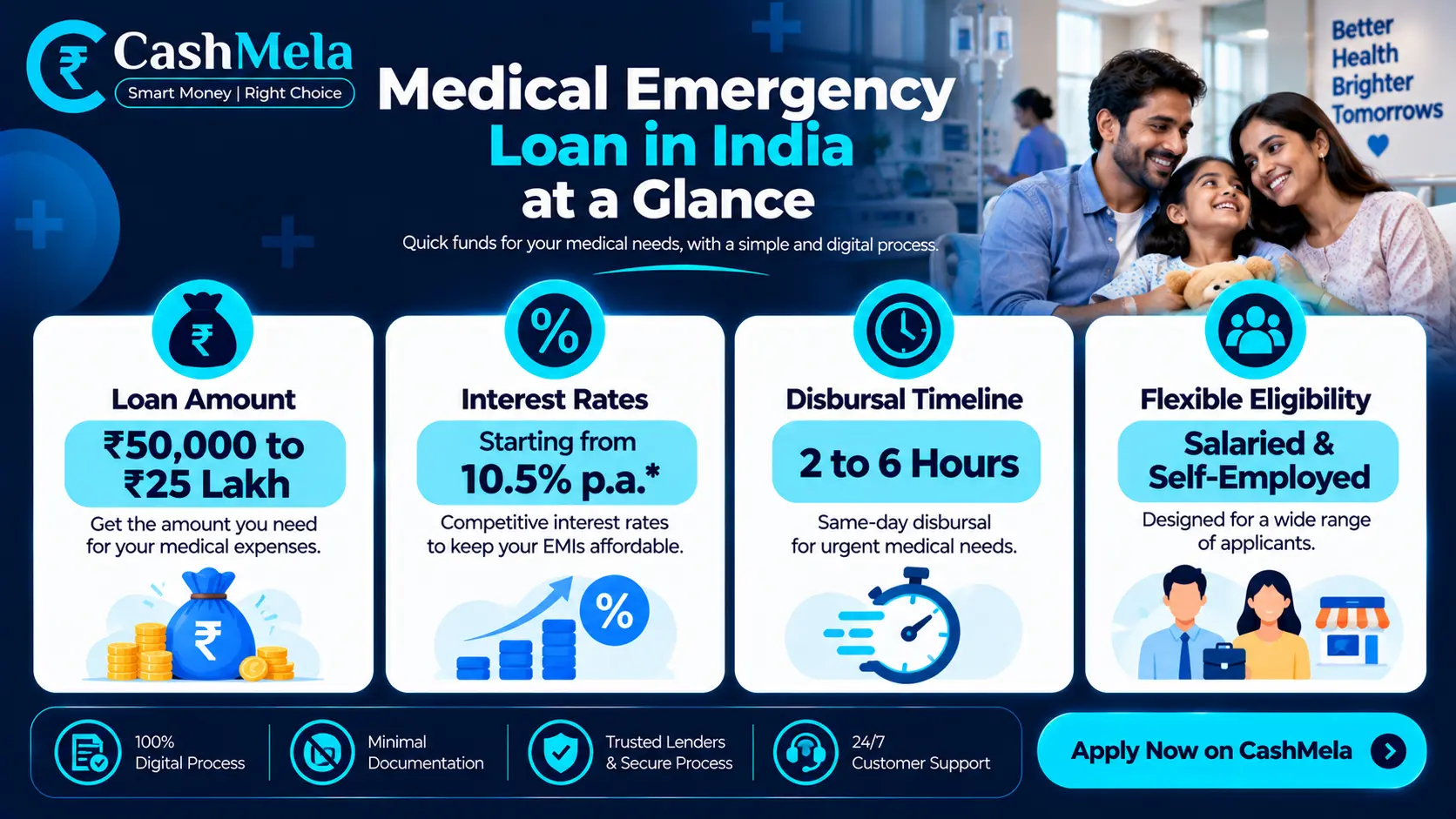
Loan amounts across most platforms in India range from ₹ 50,000 to ₹ 25 lakh. Tenure runs between twelve and sixty months. Interest rates start around 10.5 percent per annum for borrowers with strong credit profiles and scale upward based on credit score, income stability, and the lending platform. Repayment happens through fixed monthly EMIs, so once the medical situation is behind you, the financial obligation has a clear, predictable end date.
The Real Cost of Not Having a Plan for Medical Emergencies
India's private healthcare system has grown significantly more capable over the last decade. It has also grown significantly more expensive:
- An ICU admission at a private hospital in a Tier-1 city can run ₹ 20,000 to ₹ 50,000 per day.
- A cardiac bypass procedure can cost ₹ 3 to ₹ 5 lakh.
- Cancer treatment protocols often run into lakhs over multiple months.
Health insurance covers some of this, but not always enough. National Health Profile data indicates that out-of-pocket healthcare expenditure in India remains among the highest in the world relative to income. Many families with health insurance still find themselves facing substantial uncovered bills.
Sub-limits on room rent reimbursement, exclusions for specific procedures, copayment clauses, and waiting periods for pre-existing conditions all create gaps between what insurance pays and what the hospital charges.
A medical emergency loan in India steps in where the insurance coverage stops:
- It covers the gap between what the insurer reimburses and what the hospital actually charged.
- It funds costs upfront while a reimbursement claim works its way through the process.
- It covers essential procedures, consumables, and non-medical charges that the policy never included.
The loan does not compete with insurance. It completes it.
Who Can Apply for a Medical Emergency Loan in India
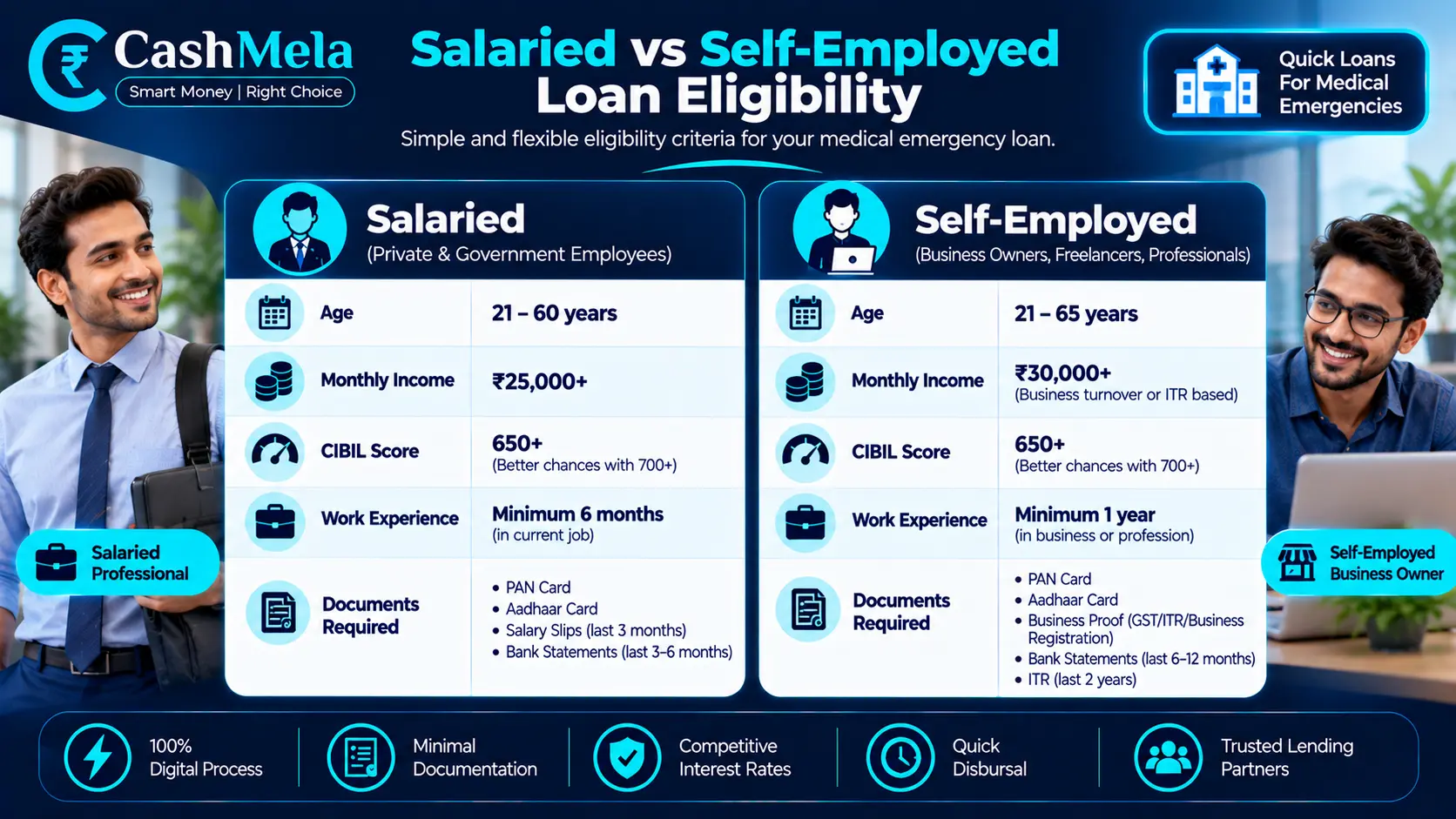
The eligibility framework for a medical emergency loan in India follows personal loan criteria at most lenders, though the specific requirements shift depending on whether you're salaried, self-employed, or applying through a bank versus an NBFC.
Salaried Applicants
- Age: Between 21 and 60 years at most lenders
- Income: Minimum monthly take-home salary of ₹ 20,000 to ₹ 25,000 depending on the city and lender
- Employment: At least six months at the current employer, with one year of total work experience preferred
- Credit Score: CIBIL score of 700 or above for bank products, 650 and above for many NBFC and fintech platforms
Self-Employed Applicants
- Age: Between 21 and 65 years
- Income: Minimum monthly income of ₹ 30,000+ or annual business income of ₹ 3 lakh to ₹ 5 lakh depending on the lender
- Vintage: Business vintage of at least one to two years
- Taxation: ITR filing for the most recent two years is typically required
- Banking: Bank statements covering the last six to twelve months of business transactions
Suresh is a freelance architect in Hyderabad. When his wife needed an urgent gallbladder surgery, he assumed his irregular income would make him ineligible. He ran a soft eligibility check on CashMela and found three NBFCs willing to lend him ₹ 1.5 lakh based on his bank statement history and most recent ITR. His application cleared the same afternoon.
Self-employed borrowers are not a special risk category. They are simply a different documentation category, and that distinction matters.
Salaried vs. Self-Employed Eligibility Comparison
| Criteria | Salaried Professionals | Self-Employed Individuals |
|---|---|---|
| Age Range | 21 – 60 years | 21 – 65 years |
| Monthly Income | ₹ 25,000+ per month | ₹ 30,000+ per month (or business turnover equivalent) |
| Minimum CIBIL Score | 650+ (Preferred 700+ for lowest rates) | 650+ (Preferred 700+ for best terms) |
| Experience / Vintage | Minimum 6 months in current job | Minimum 1 year in active business/profession |
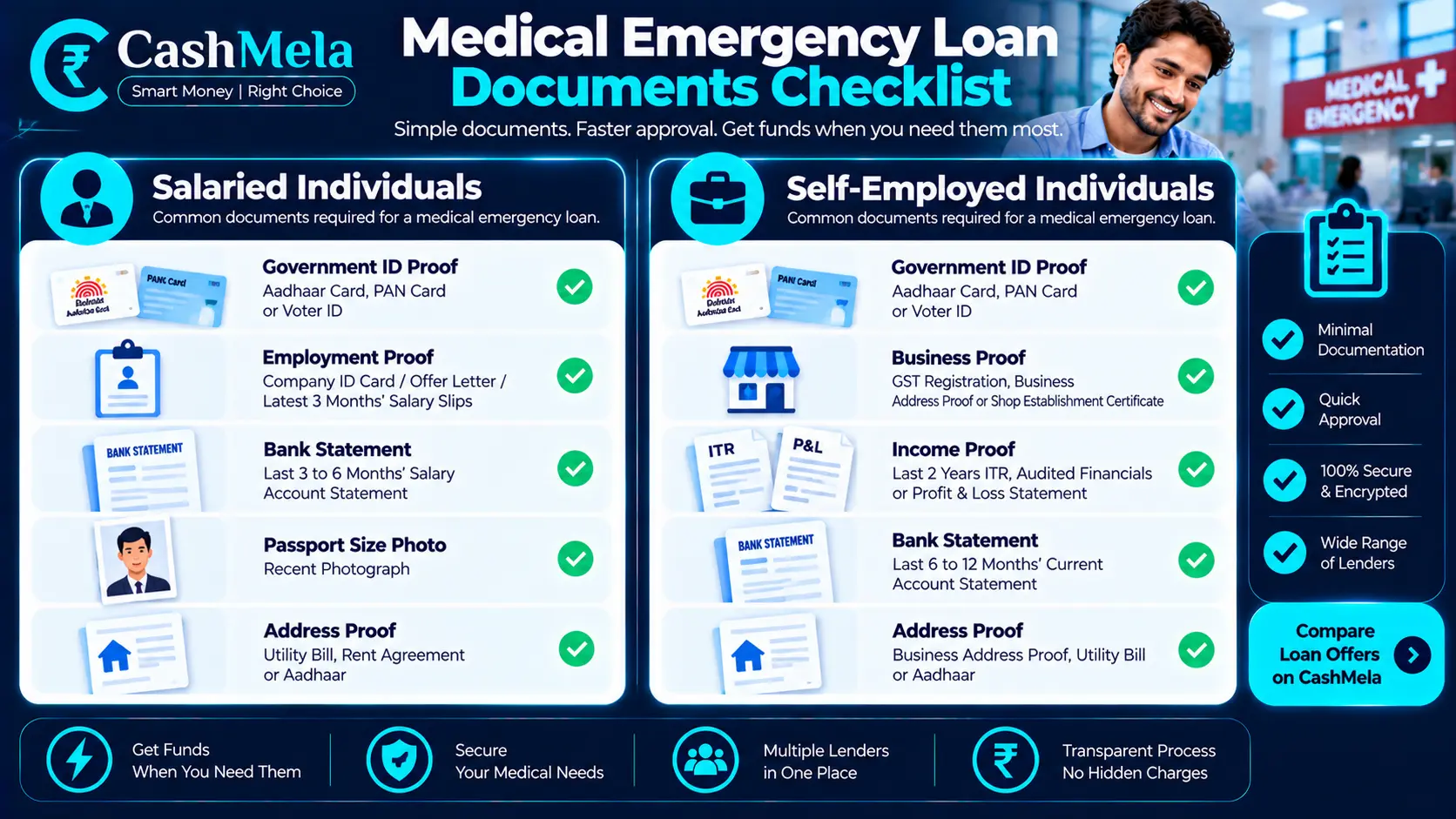
| Documents Required | PAN, Aadhaar, salary slips (3 mos), bank statements (3-6 mos) | PAN, Aadhaar, business proof (GST/ITR), bank statements (6-12 mos), ITR (2 yrs) |
How to Apply for a Medical Emergency Loan in India Step by Step
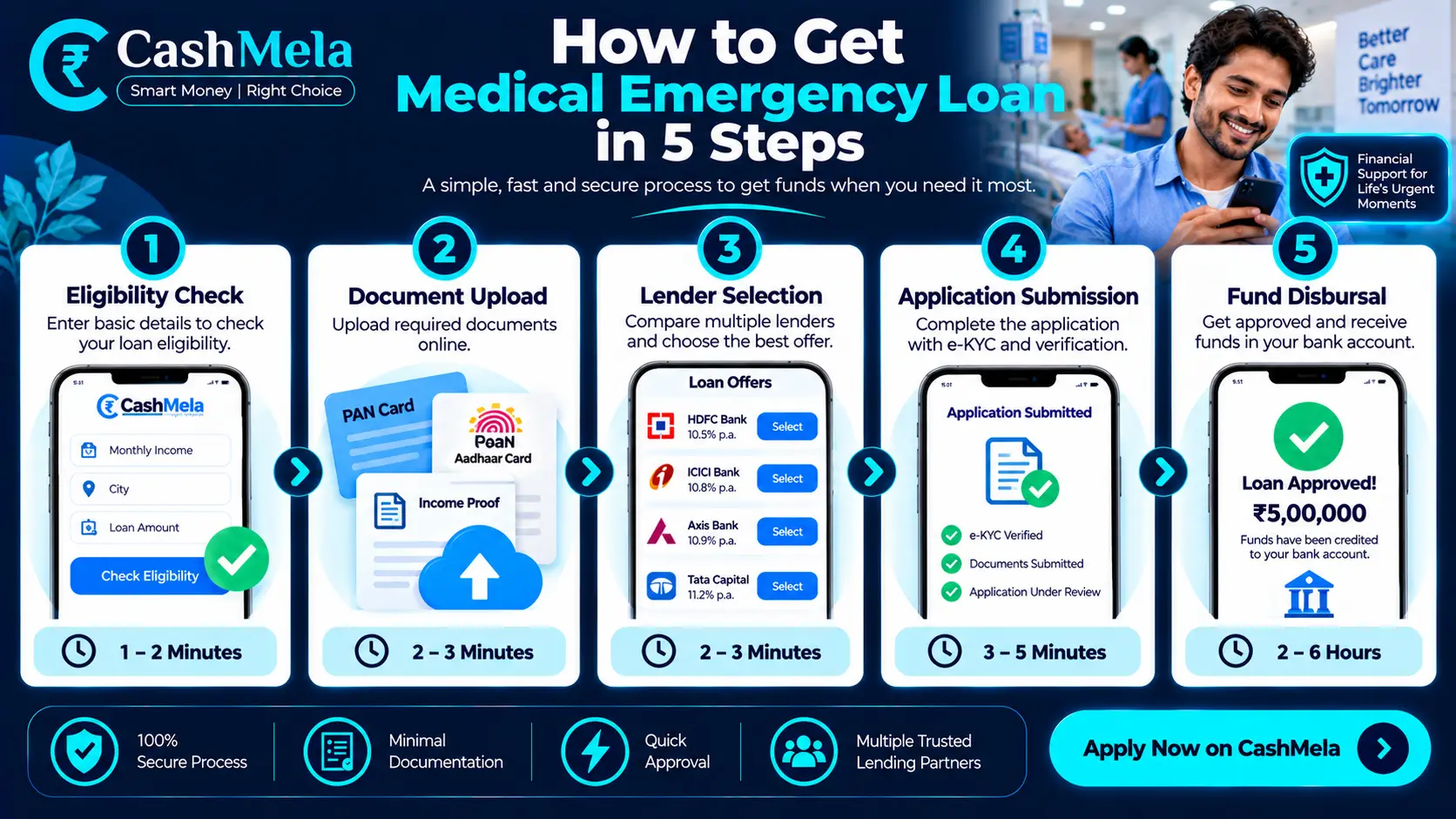
Digital lending has changed the application experience significantly over the past few years. What once required branch visits and days of waiting now happens entirely on a phone:
- Start with a soft eligibility check, not a formal application: Platforms like CashMela let you see which lenders match your profile and at what indicative rate before any formal application is submitted. No hard inquiry hits your credit report at this stage. During a medical emergency, that five-minute step can save you from a rejected application that damages your score right when you need credit most.
- Get your documents into digital format in advance: Salaried applicants need PAN, Aadhaar, two to three recent salary slips, and six months of bank statements. Self-employed applicants need PAN, Aadhaar, twelve months of business account statements, and the most recent ITR. Keep photographed copies of all of these in a dedicated folder on your phone. In an emergency, the difference between a ten-minute application and a forty-minute scramble is usually this one step.
- Submit through the lender's app or website: Most platforms complete the entire application, including Aadhaar-based e-KYC, document upload, and credit assessment, within a single digital session of ten to fifteen minutes.
- Review the offer before accepting: The lender presents a formal offer with sanctioned amount, interest rate, processing fee, tenure options, and EMI. Note the net disbursal amount after the processing fee is deducted. If you need ₹ 1.5 lakh and a 2 percent processing fee applies, request ₹ 1.53 lakh to ensure the net amount covers your actual need.
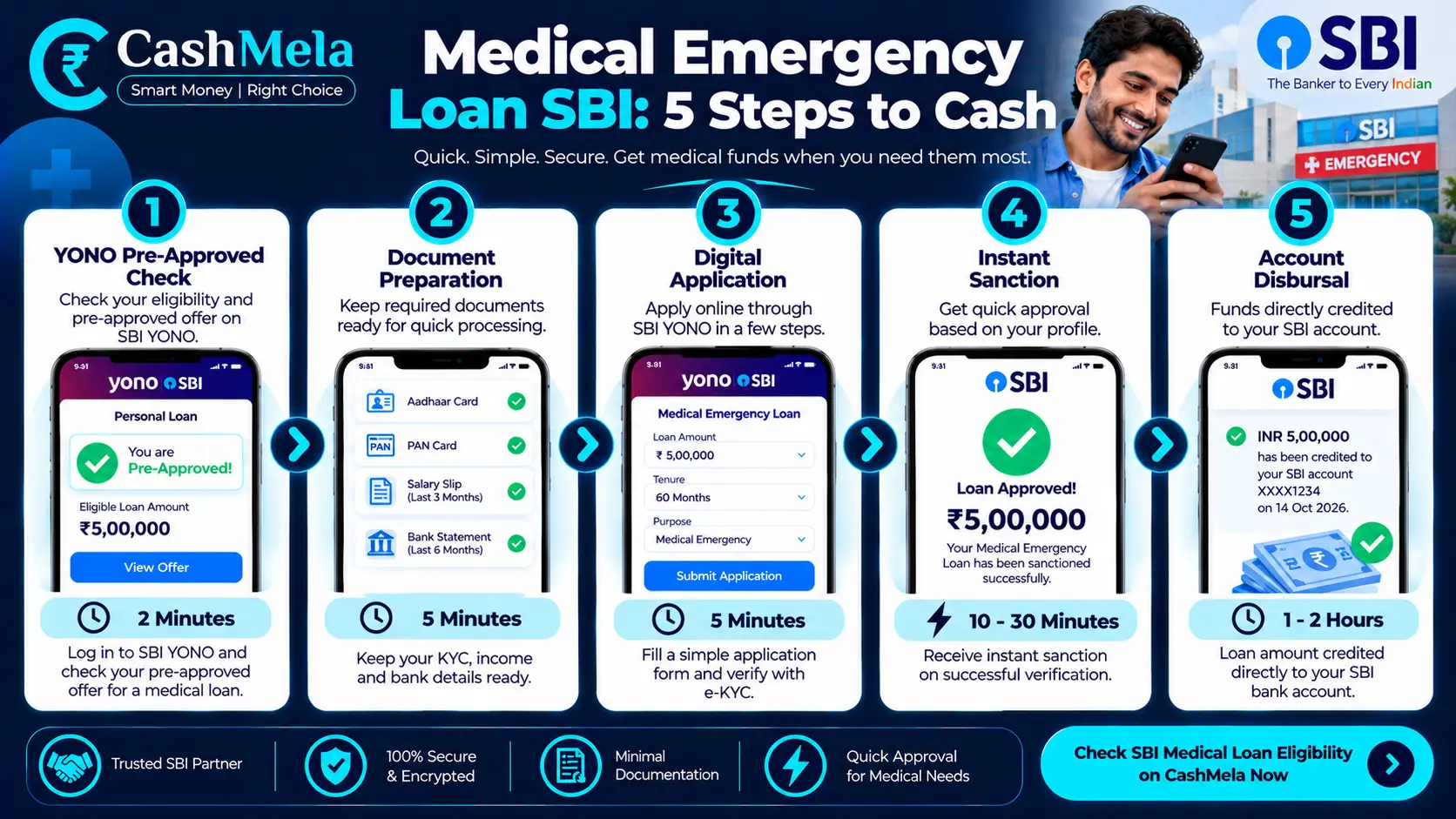
- Receive funds: For eligible profiles on digital platforms, disbursal happens within two to six hours of offer acceptance. Existing customers with pre-approved offers from their salary account bank may see funds within minutes.
Types of Lenders Offering a Medical Emergency Loan in India
The lending landscape for a medical emergency loan in India spans several categories, each with different trade-offs:
1. Private Sector Banks
Offer competitive interest rates and strong brand credibility. Best suited for borrowers who already hold accounts with the bank, since pre-approved offers for existing customers typically disburse the fastest. New applicants without an existing relationship may face a slightly longer process.
2. Regulated NBFCs
Non-banking financial companies fill a significant gap in India's lending ecosystem by approving profiles that don't meet the stricter criteria of traditional banks. For borrowers with CIBIL scores between 650 and 700, or with non-standard income patterns, NBFCs are often the most accessible source for a medical emergency loan in India.
3. Digital Lending Platforms and Fintech Apps
These platforms run the most automated underwriting processes and typically deliver the fastest disbursal timelines. Many are backed by NBFC partners and operate under RBI regulation. The trade-off is that interest rates can be slightly higher than what a bank would offer for equivalent profiles.
4. Loan Comparison Platforms (CashMela)
Platforms like CashMela don't lend directly but aggregate offers from multiple lenders, allowing borrowers to compare terms across banks, NBFCs, and fintech lenders simultaneously without submitting multiple applications. For a medical emergency loan in India, this is the most efficient starting point because it surfaces the best offer for your specific profile across the entire market in one step.
Lender Landscape Comparison
| Lender Category | Best Suited For | Typical Disbursal Speed | Indicative Rate Range |
|---|---|---|---|
| Salary Account Banks | Existing banking customers with pre-approvals | Minutes to a few hours | 10.5% – 15% p.a. |
| Private Banks (New) | Prime borrowers (CIBIL 720+) with high income | 1 to 2 business days | 10.5% – 16% p.a. |
| Regulated NBFCs | Flexible profiles, self-employed & CIBIL 650+ | 2 to 6 hours | 12% – 20% p.a. |
| Fintech Loan Aggregators (CashMela) | Multi-lender instant soft comparison across 40+ partners | 2 to 4 hours | Best competitive match |
Frequently Asked Questions
Q1: How fast can I get a medical emergency loan in India disbursed?
A: For eligible applicants on digital lending platforms, disbursal typically happens within two to six hours of loan acceptance. Existing bank customers with pre-approved offers may see funds credited within minutes. First-time applicants without a prior banking relationship may take up to one business day at traditional banks.
Q2: What CIBIL score do I need for a medical emergency loan in India?
A: Most bank products require a minimum CIBIL score of around 700. NBFCs and fintech platforms often work with profiles from 650 onwards. Some platforms that specialise in emergency lending will consider lower scores in exchange for a higher interest rate. Running a soft eligibility check first helps identify which lenders match your current profile.
Q3: Does a medical emergency loan in India require hospital documentation?
A: Most unsecured personal loan products used for medical emergencies do not require hospital bills or treatment documentation. The loan is disbursed as cash and you use it as needed. Some hospital-tied EMI products may require documentation, but standard digital lending apps do not.
Q4: Can I apply for a medical emergency loan in India for a parent or sibling?
A: Yes. The loan is taken in your name and repaid by you, but the funds can cover treatment costs for any family member. There is no restriction on whose medical bills the loan proceeds are applied toward.
Q5: What happens if I miss an EMI on a medical emergency loan in India?
A: A missed EMI triggers a late payment penalty and a negative mark on your CIBIL report. If you anticipate difficulty repaying due to reduced income during or after a family member's treatment, contact the lender before the due date. Most regulated lenders have provision for restructuring or a short moratorium for genuine hardship cases, but you need to initiate that conversation proactively.
Q6: Is there a tax benefit on a medical emergency loan in India?
A: A personal loan used for medical purposes does not attract a standard income tax deduction on the loan interest itself. However, expenses incurred for specific critical illnesses may qualify for deduction under Section 80DDB of the Income Tax Act, subject to applicable conditions and limits. Consult a tax professional for your specific situation.
Q7: How much can I borrow through a medical emergency loan in India?
A: Loan amounts typically range from ₹ 50,000 to ₹ 25 lakh depending on the lender and your credit profile. The sanctioned amount is generally calculated as a multiple of your monthly income within the lender's internal cap. Running an eligibility check on a comparison platform gives you a realistic figure before you commit to any formal application.
Conclusion
Healthcare costs in India have moved faster than most household savings plans anticipated. Having access to a medical emergency loan in India, knowing which platforms to trust, understanding what documents you need, and knowing roughly what you'll qualify for before the moment of crisis, is no longer just useful background knowledge. It's practical preparation for a situation that visits more families than anyone expects.
The medical emergency loan in India infrastructure is ready. The question is simply whether you are.
Ready to check what you qualify for today? Apply free on CashMela and compare medical emergency loan in India offers across 40+ lenders in minutes, with no impact on your credit score.
Explore Related Financial Guides:
- 🏥 Medical Emergency Loan Guide: Fast Funds When You Need It
- 📲 Medical Emergency App Loan: The Fastest Way to Fund a Health Crisis
- 🆓 Medical Emergency Loan App Free: Top Picks 2026
- 💰 Compare Personal Loans from 40+ Lenders
- 📊 Free CIBIL Credit Score Check Guide
- 🧮 Free Personal Loan EMI Calculator
- 🔄 Debt Consolidation Strategy Guide
Stay Informed, Stay Ahead!
Follow Cashmela on social media for more practical finance guides, loan tips, and the latest updates:
- 💰 Instagram: @cashmela_com – Simple finance tips and real borrower stories
- 👍 Facebook: Cashmela – Join the conversation and never miss an update
- 🐦 X (Twitter): @cash_mela – Quick updates and finance news
- 💼 LinkedIn: Cashmela – Industry insights and company updates
✨ Let's make smarter borrowing simple, together!
Disclaimer: Loan terms, interest rates, and eligibility criteria mentioned in this article are indicative and subject to change. Please verify the latest information with your chosen lender before making any financial decision. This article is for informational purposes only and does not constitute financial or medical advice.

Samarth Shigvan
Marketing Head & Growth LeadAuthor & Financial Analyst at CashMela.com
Samarth Shigvan is the Marketing Head at Cashmela.com. He oversees brand strategy, performance marketing, SEO, and borrower educational initiatives across India. Samarth is passionate about simplifying complex financial topics—such as CIBIL score optimization, interest rates comparison, and debt freedom strategies—into actionable, transparent guides for everyday consumers.