Introduction
At 2 am, Priya's father collapsed with chest pain. By 6 am he was stable but needed immediate surgery, and the hospital wanted ₹ 1.8 lakh deposited before the procedure could begin. Priya's savings were roughly half that figure.
She pulled out her phone, filled out a medical emergency loan application on a comparison platform, and had approval confirmation before the pre-operation prep was done. The funds landed in her account before the billing desk opened for the day.
Nobody should have to choose between a family member's health and a bank balance. A medical emergency loan exists precisely so that choice doesn't have to happen. What follows is everything worth knowing before you ever need one.
What a Medical Emergency Loan Actually Is
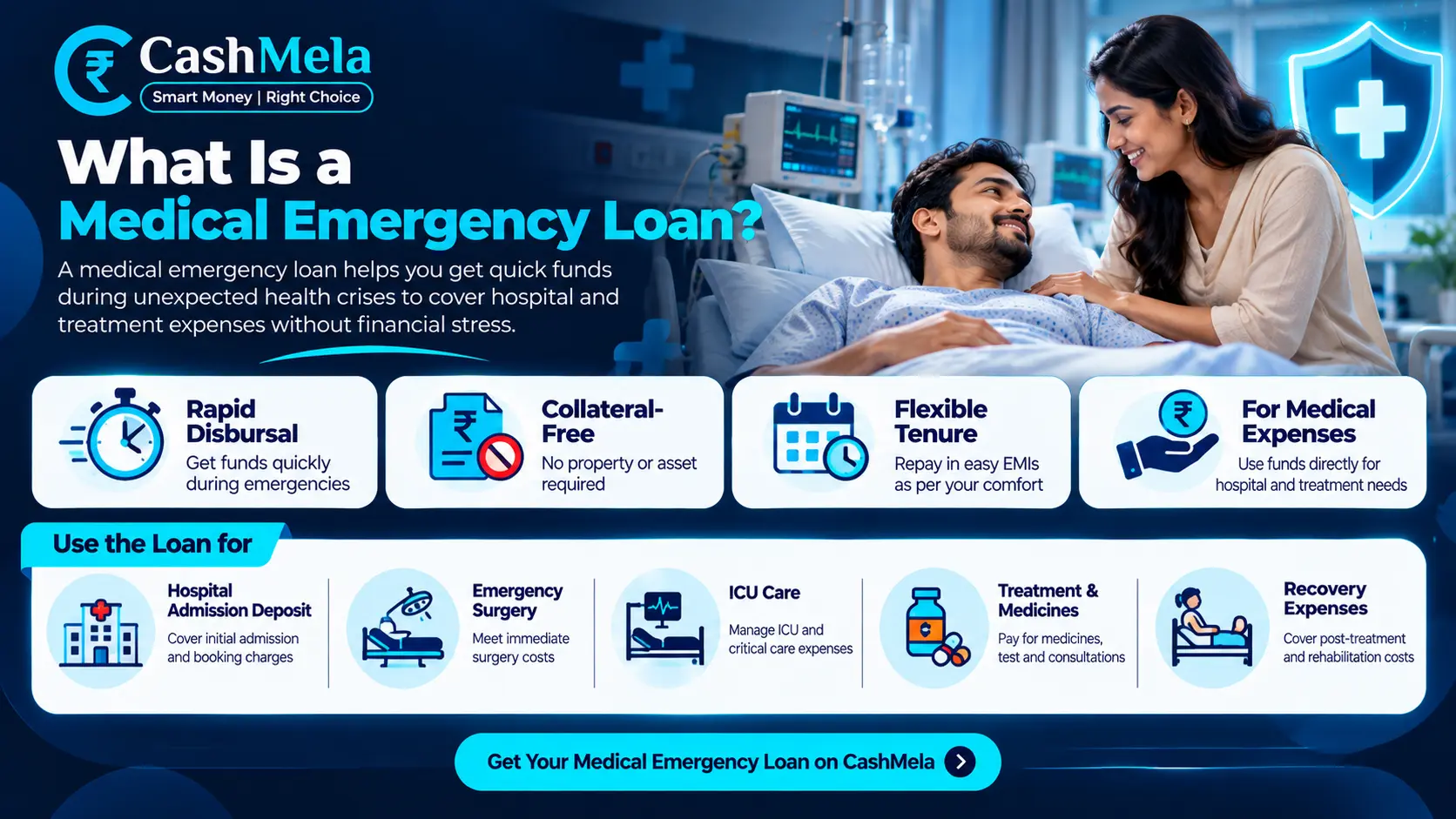
Strip away the category name and a medical emergency loan is structurally an unsecured personal loan, just one applied to healthcare costs.
The mechanics are straightforward: a lender disburses a fixed amount into your bank account, you repay it through monthly EMIs across a chosen period, and interest accrues on whatever principal remains outstanding each month.
What sets it apart is context and speed. Lenders who offer medical emergency loan products understand that the approval and disbursal timeline needs to match the urgency of a health crisis, not the pace of a routine loan application.
What Most Medical Emergency Loans in India Cover:
- Hospital admission deposits and surgery costs: Immediate upfront payments demanded prior to emergency procedures.
- ICU charges and specialist consultation fees: Critical care and intensive monitoring expenses.
- Diagnostic tests, scans, and lab work: MRI, CT scans, blood work, and pathology evaluations.
- Post-hospitalisation medication and recovery care: Rehabilitation, extended therapies, and specialist drugs.
- Costs not covered under existing health insurance: Non-medical items, consumables, and policy co-payments.
- Medical travel or air ambulance expenses: Patient transfer between cities or specialized tertiary centres in critical cases.
The loan amount typically ranges from ₹ 50,000 up to ₹ 25 lakh or more depending on the lender and your credit profile. Tenure usually sits between 12 and 60 months, giving you flexibility on the monthly EMI. Interest rates start around 10.5 percent per annum for well-qualified borrowers and can go higher depending on your CIBIL score and income.
Why a Medical Emergency Loan Makes Sense Over Other Options
When a health crisis hits, people reach for whatever financial tool they can find first. Credit cards, borrowing from family, breaking a fixed deposit. Each of these has its place, but a medical emergency loan often makes more sense for larger amounts and longer recovery periods.
Credit Cards
Credit cards work for small, immediate expenses but their revolving interest rate—typically 36 to 42 percent per annum on outstanding balances—makes them extraordinarily expensive for anything you can't clear within a billing cycle. A medical emergency loan converts the debt into a fixed EMI at a fraction of that rate (from 10.5% p.a.).
Breaking a Fixed Deposit
Breaking a fixed deposit means losing the interest you've built up and potentially incurring a premature withdrawal penalty. If the FD is your emergency buffer for other situations, depleting it leaves your household exposed on multiple fronts.
Borrowing from Family
Borrowing from family solves the immediate problem but introduces relational pressure, particularly when recovery is slow and repayment timelines become uncertain. A medical emergency loan keeps the financial obligation formal, predictable, and entirely within your own hands.
Bridging Health Insurance Gaps
Health insurance covers planned and some emergency hospitalisation, but gaps are common. Pre-existing condition exclusions, sub-limits on room rent or specific procedures, copayments, and waiting periods for certain treatments mean the claim payout often falls short of the actual hospital bill. A medical emergency loan fills that gap cleanly.
How to Apply for a Medical Emergency Loan Quickly
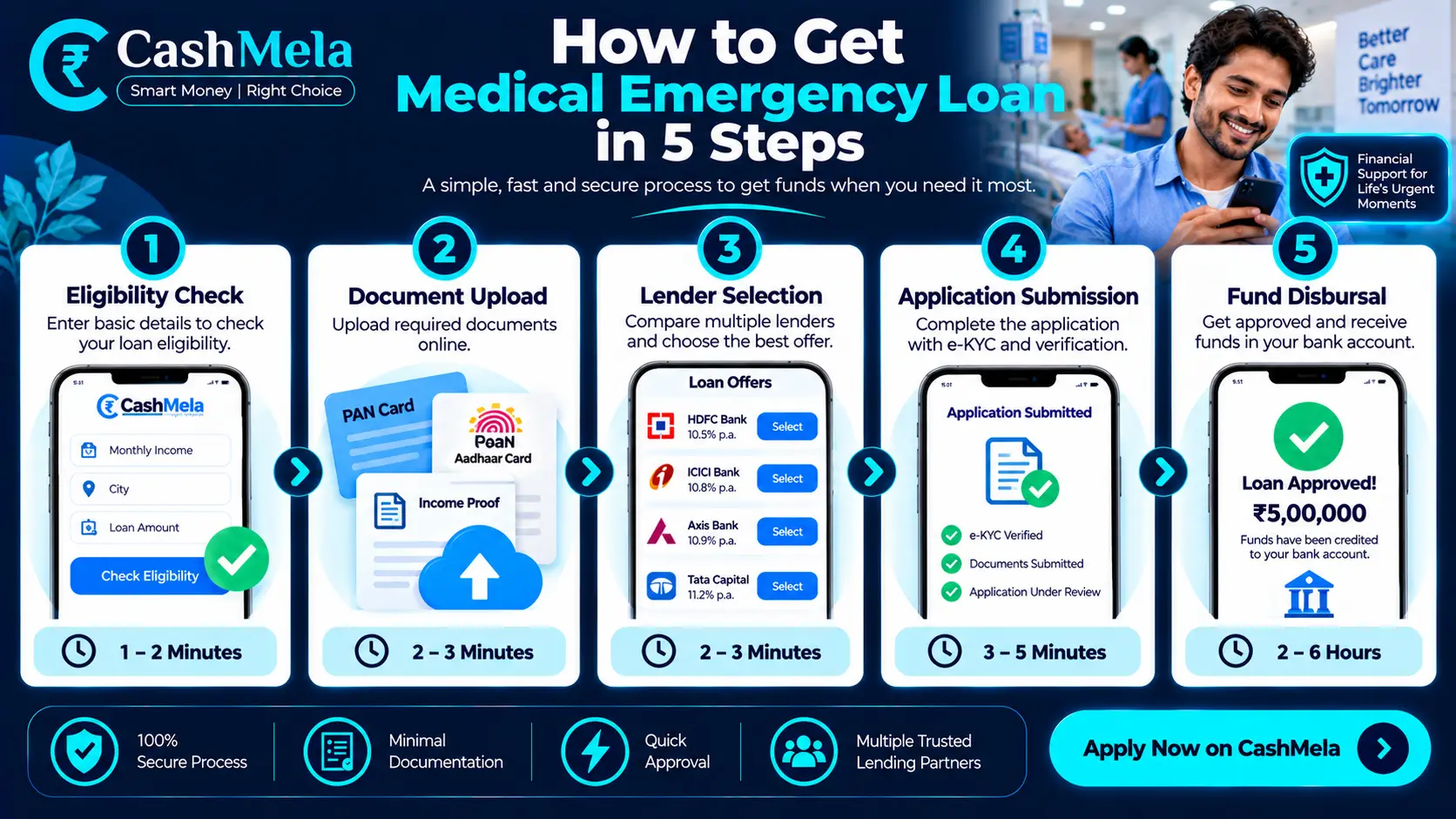
Speed matters here. Here's how to move from application to approval as fast as possible:
Step 1: Check Your Eligibility Before Applying
Before submitting a formal application anywhere, use a comparison platform like CashMela to run a soft eligibility check across multiple lenders simultaneously. This shows you which lenders are likely to approve your profile and at what rate, without triggering any hard inquiries on your credit report. Knowing your best options upfront saves time you don't have in an emergency.
Step 2: Keep Documents Ready
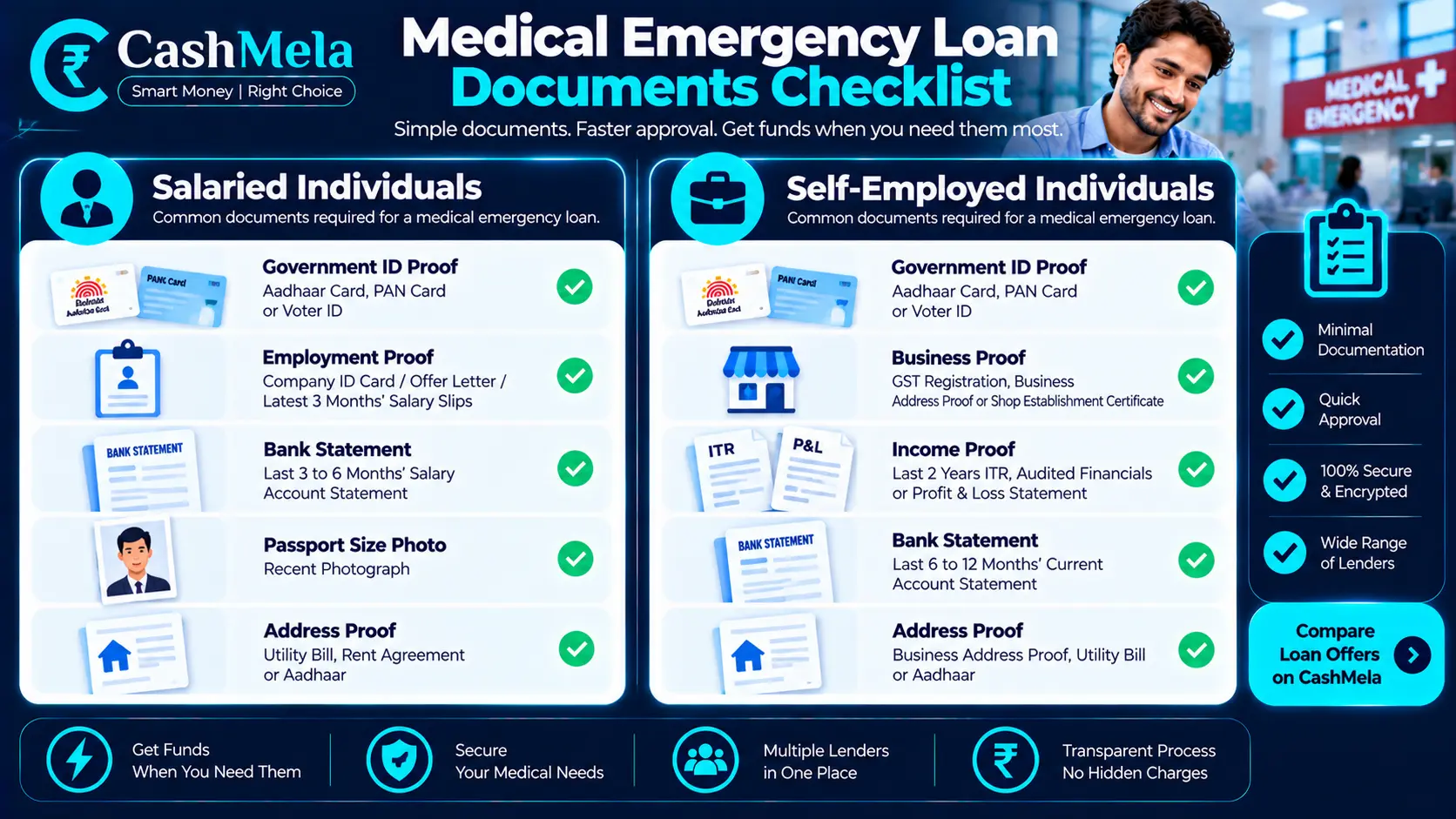
For most digital lenders, a medical emergency loan application requires:
- PAN card and Aadhaar card
- Salary slips covering the past two to three months, or bank statements if self-employed
- Latest bank statement showing salary credits
- Basic personal and employment details
Many lenders complete KYC entirely via Aadhaar-based e-verification. No physical documents, no branch visit. The application itself takes under ten minutes on a mobile phone.
Step 3: Choose the Right Lender for Your Situation
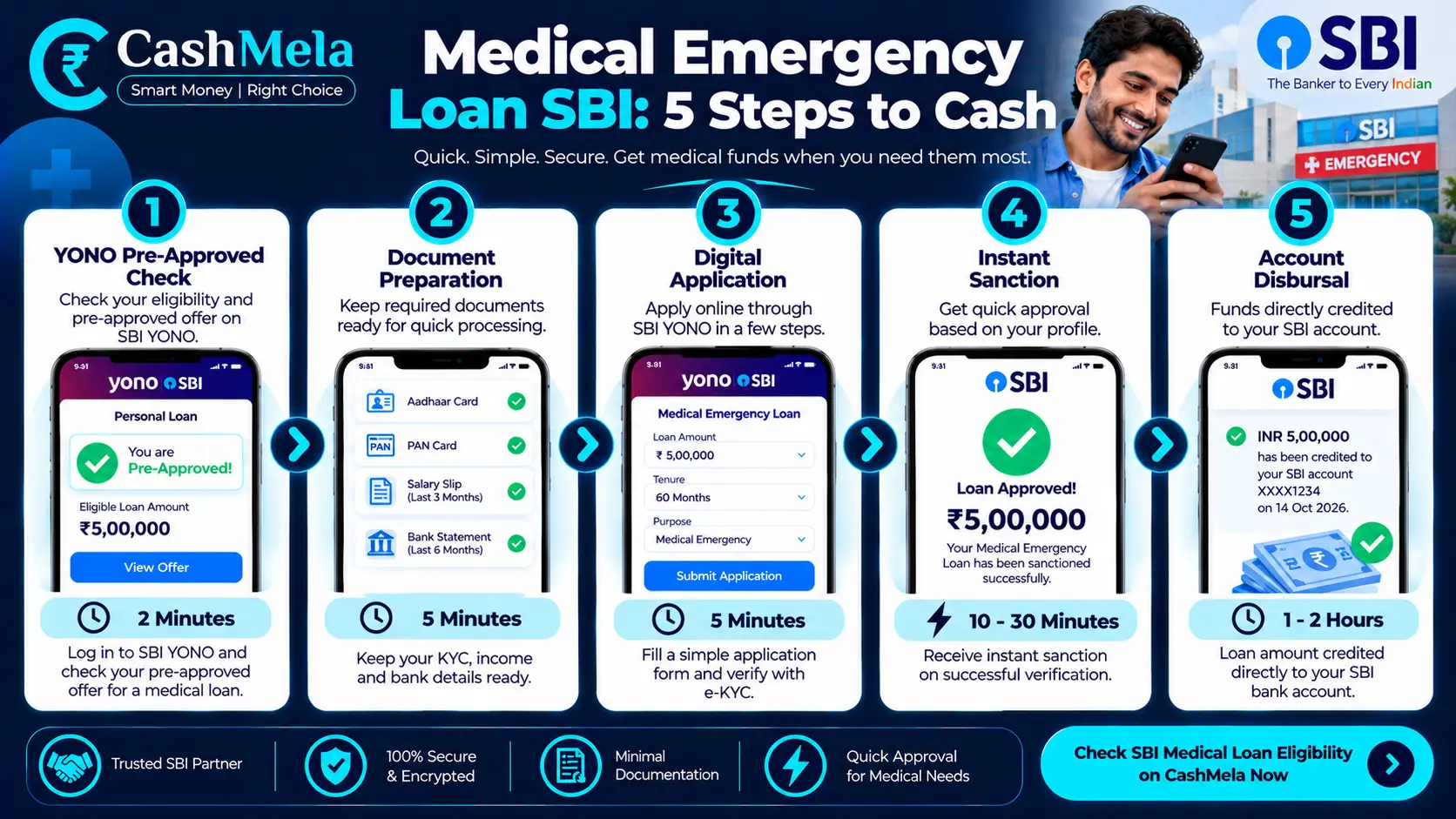
Start with whichever bank holds your salary account. Log in and look for a pre-approved loan section before going anywhere else. When a bank already has months of your transaction data, it can approve and disburse in minutes without asking for any documents.
If no pre-approved offer exists, digital lenders and NBFCs are the next fastest option, with disbursal windows of two to four hours in most cases. Going to a bank with no prior relationship during an active emergency is a last resort—the paperwork and processing time rarely fit the urgency of a hospital waiting room.
Step 4: Pick a Tenure That Fits Your Recovery Budget
Don't default to the longest tenure available just because it gives the lowest EMI. Run the total interest calculation for two or three tenure options and weigh them against your expected income over the coming months. If you're the primary earner and the patient, a longer tenure with a lighter EMI makes real sense. If the patient is a family member and your income is stable, a shorter tenure saves considerably on total interest paid.
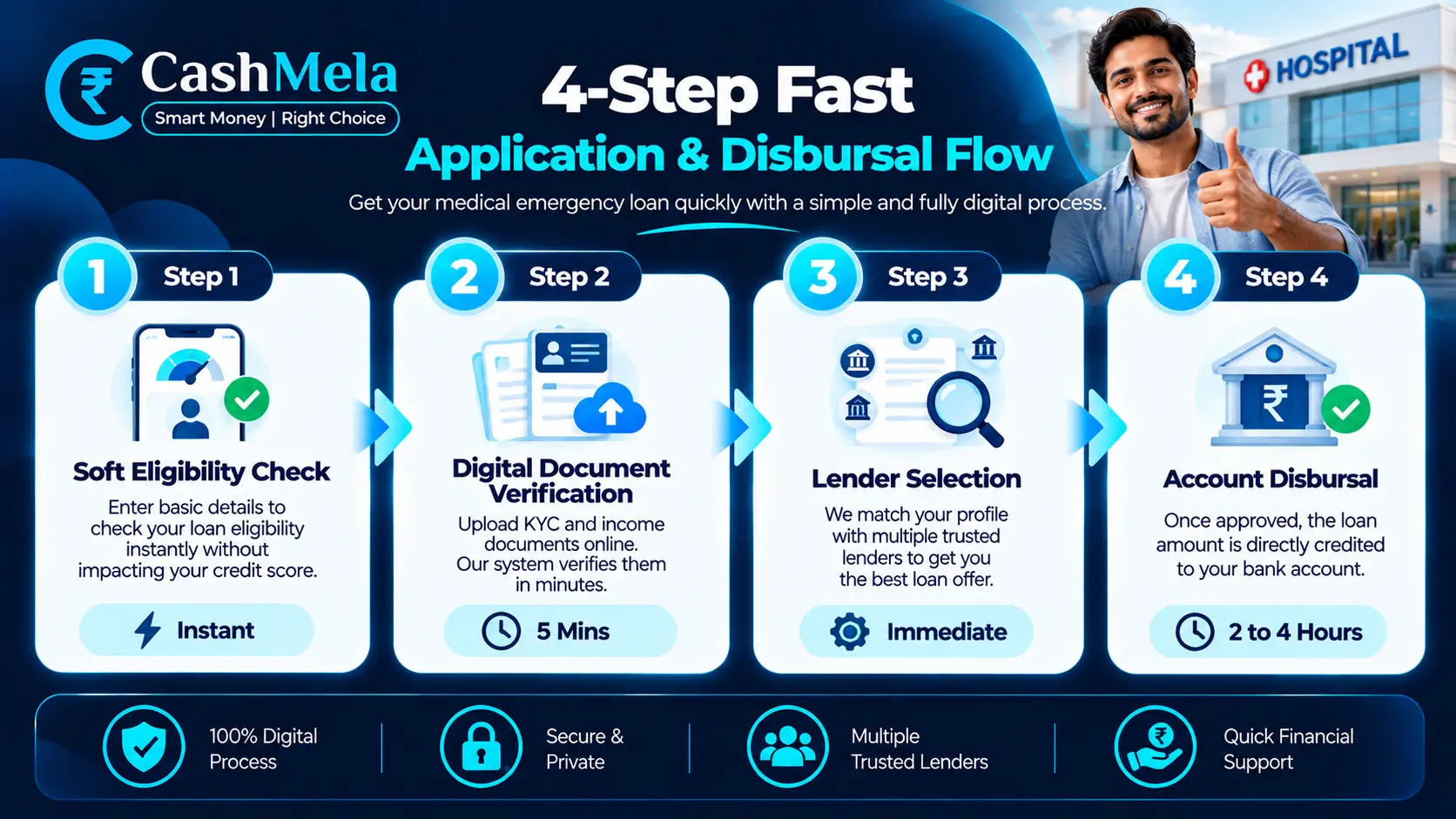
Fast Application & Disbursal Flow
| Step | Action Stage | Typical Turnaround | Key Requirement |
|---|---|---|---|
| Step 1 | Soft Eligibility Check | Instant | PAN & mobile check (zero credit impact) |
| Step 2 | Digital Document Verification | 5 Minutes | Aadhaar OTP e-KYC & salary statements |
| Step 3 | Lender Matching & Approval | Immediate | Best rate comparison across 40+ lenders |
| Step 4 | Direct Bank Disbursal | 2 to 4 Hours | Funds credited directly to your bank account |
What Affects Your Medical Emergency Loan Approval and Rate
Not everyone gets the same rate or approval speed. Several key factors shape what a lender offers you:
1. CIBIL Score
A score of 750 and above puts you in line for the fastest approvals and lowest rates on a medical emergency loan. Scores between 680 and 749 will still get approved at most NBFCs and digital lenders, though the rate will be higher. If your score is lower, you may need to look at lenders who specifically serve lower-score profiles, or consider a smaller loan amount to improve approval odds.
2. Income Stability
Lenders want to see that your salary comes in regularly and consistently. A steady salary account with three to six months of clean credits is a strong signal. Self-employed applicants will typically need to show business account statements and ITR alongside personal income proof.
3. Existing Debt Load
If your current EMIs already account for a large share of your monthly income, a lender may reduce the amount they're willing to offer or decline the application. Keeping total EMI commitments under 50 percent of take-home pay is the working benchmark most lenders use.
4. Employer and Employment Type
Employees of large corporates, government organisations, and listed companies typically receive faster approvals and better rates because the income source is considered more stable. That doesn't mean others are excluded, just that the process may involve a slightly closer look at income documents.
Medical Emergency Loan vs Health Insurance: Understanding the Gap
These two financial safety nets serve different functions, and understanding how they interact is essential during a crisis:
How They Compare:
| Feature | Medical Emergency Loan | Health Insurance Policy |
|---|---|---|
| Fund Access | Cash transferred directly to your bank account | Cashless hospital desk or post-discharge claim |
| Coverage Scope | 100% of all hospital, pharmacy, and travel expenses | Capped by room rent sub-limits, copays & exclusions |
| Eligible Out-of-Pocket Bills | Covers medical consumables, diagnostics & attendant costs | Excludes non-medical charges & procedure caps |
| Approval Timeline | Instant paperless verification; 2 to 4 hour payout | 2 to 6 hours for cashless; 15 to 30 days for claims |
Health insurance pays the hospital directly, or reimburses you after you pay, for covered treatments up to your policy limit. It's the right first line of defence. But in practice, a significant portion of large medical bills end up uncovered. Room rent sub-limits mean the insurer only pays for a basic room even if the patient needed an ICU. Specific procedures may have fixed benefit caps that don't reflect actual costs. Out-of-pocket expenses on consumables, certain medicines, and non-medical charges are almost never covered.
A medical emergency loan covers all of it, covered or not, because it's cash in your account. You decide where it goes. If the insurance covered 60 percent of the bill and the hospital wants the remaining 40 percent before discharge, the loan clears that amount immediately. It doesn't negotiate with the hospital on your behalf. It just gives you the money to settle the situation and leave.
Having both is not redundant. For anyone who relies primarily on insurance without a sizeable liquid emergency fund, a medical emergency loan is the backstop that makes the coverage actually complete.

Frequently Asked Questions
Q1: How quickly can I get a medical emergency loan disbursed?
A: For pre-approved customers with existing bank relationships, disbursal can happen within minutes. For new applicants on digital lending platforms, two to four hours is typical for eligible profiles with complete documentation. Traditional bank applications without a prior relationship may take one to two business days.
Q2: What amount can I borrow through a medical emergency loan?
A: Loan amounts generally range from ₹ 50,000 to ₹ 25 lakh depending on the lender and your credit profile. Some lenders go higher for well-qualified applicants. The amount sanctioned is typically a multiple of your monthly income, capped by the lender's internal policy.
Q3: Do I need to show hospital bills to apply for a medical emergency loan?
A: Most personal loan-based medical emergency loan products do not require you to show hospital bills or medical documentation. The loan is disbursed as cash to your account and you use it as needed. A few lenders have dedicated medical loan products with hospital tie-ups that require documentation, but these are less common for emergency situations.
Q4: What if my CIBIL score is low? Can I still get a medical emergency loan?
A: Yes, though the options narrow. Several NBFCs and digital lenders work with scores in the 650 to 699 range. Secured loan options, where you offer an asset as collateral, are accessible at lower score levels. In genuine emergencies, some hospitals also have tie-ups with finance companies that offer on-the-spot credit without a formal credit check, though rates on these tend to be higher.
Q5: Will taking a medical emergency loan affect my credit score?
A: The application itself triggers a hard inquiry which has a small short-term effect. The loan account appears on your credit report like any other loan. If you repay on time, it actually builds your credit history positively over time. Missing EMIs will negatively impact your score, so it's important to choose a tenure where the monthly payment is genuinely manageable.
Q6: Can I use a medical emergency loan for a family member's treatment?
A: Yes. There's no restriction on whose medical treatment the funds are used for. The loan is in your name and the repayment obligation is yours, but the money can cover treatment for a parent, spouse, child, or any other family member.
Q7: Is there a tax benefit on a medical emergency loan?
A: Unlike home loans, personal loans including medical emergency loans do not come with a standard income tax deduction under the Income Tax Act. However, if the loan is used for specific critical illnesses covered under Section 80DDB, you may be eligible for deduction on the treatment expenses themselves. Consult a tax advisor for your specific situation.
Conclusion
Medical emergencies don't give advance notice and hospital bills don't wait for payday. A medical emergency loan exists specifically for the gap between when care is needed and when money is available, and in 2026, getting one is faster and less complicated than most people realise.
The key is knowing your options before the crisis arrives, not during it. Bookmark a comparison platform, check your eligibility in advance, and know which lenders can move fast for your profile. When the moment comes, that preparation is what lets you focus on the person in front of you instead of the billing counter behind you.
Ready to check your eligibility right now? Apply for a medical emergency loan on CashMela and compare offers from 40+ lenders in minutes, free, with no impact on your credit score.
Explore Related Financial Guides:
- 💰 Compare Personal Loans from 40+ Lenders
- 📊 Free CIBIL Credit Score Check Guide
- 🧮 Free Personal Loan EMI Calculator
- 📈 What Is a Good CIBIL Credit Score
- 📖 What Is CIBIL Credit Score: Complete Guide
- 🔄 Debt Consolidation Strategy Guide
Stay Informed, Stay Ahead!
Follow Cashmela on social media for more practical finance guides, loan tips, and the latest updates:
- 💰 Instagram: @cashmela_com – Simple finance tips and real borrower stories
- 👍 Facebook: Cashmela – Join the conversation and never miss an update
- 🐦 X (Twitter): @cash_mela – Quick updates and finance news
- 💼 LinkedIn: Cashmela – Industry insights and company updates
✨ Let's make smarter borrowing simple, together!
Disclaimer: Loan terms, interest rates, and eligibility criteria mentioned in this article are indicative and subject to change. Please verify the latest information with your chosen lender before making any financial decision. This article is for informational purposes only and does not constitute financial or medical advice.

Adil Patel
Founder & Chief Executive OfficerAuthor & Financial Analyst at CashMela.com
Adil Patel is the Founder of Cashmela.com. With over a decade of deep domain expertise across Indian banking, debt restructuring, and digital lending, Adil established Cashmela to liberate Indian borrowers from predatory credit card interest traps and opaque multi-EMI debt burdens. Under his leadership, Cashmela has helped over 50,000 borrowers consolidate EMIs into single, transparent, and affordable repayment plans.