Introduction
Arjun had never given his credit score a second thought. At 31, he was earning well, paying his bills mostly on time, and felt confident when he walked into a bank to apply for a home loan. The banker typed in his PAN number, waited a few seconds, and then asked if he had looked at his credit report recently. He hadn't. His score was 634.
Understanding what is CIBIL credit score, what makes it go up, and what quietly pulls it down would have changed that number before it mattered. This guide covers all of it, in plain language, from the ground up.
What Is CIBIL Credit Score: The Basic Definition
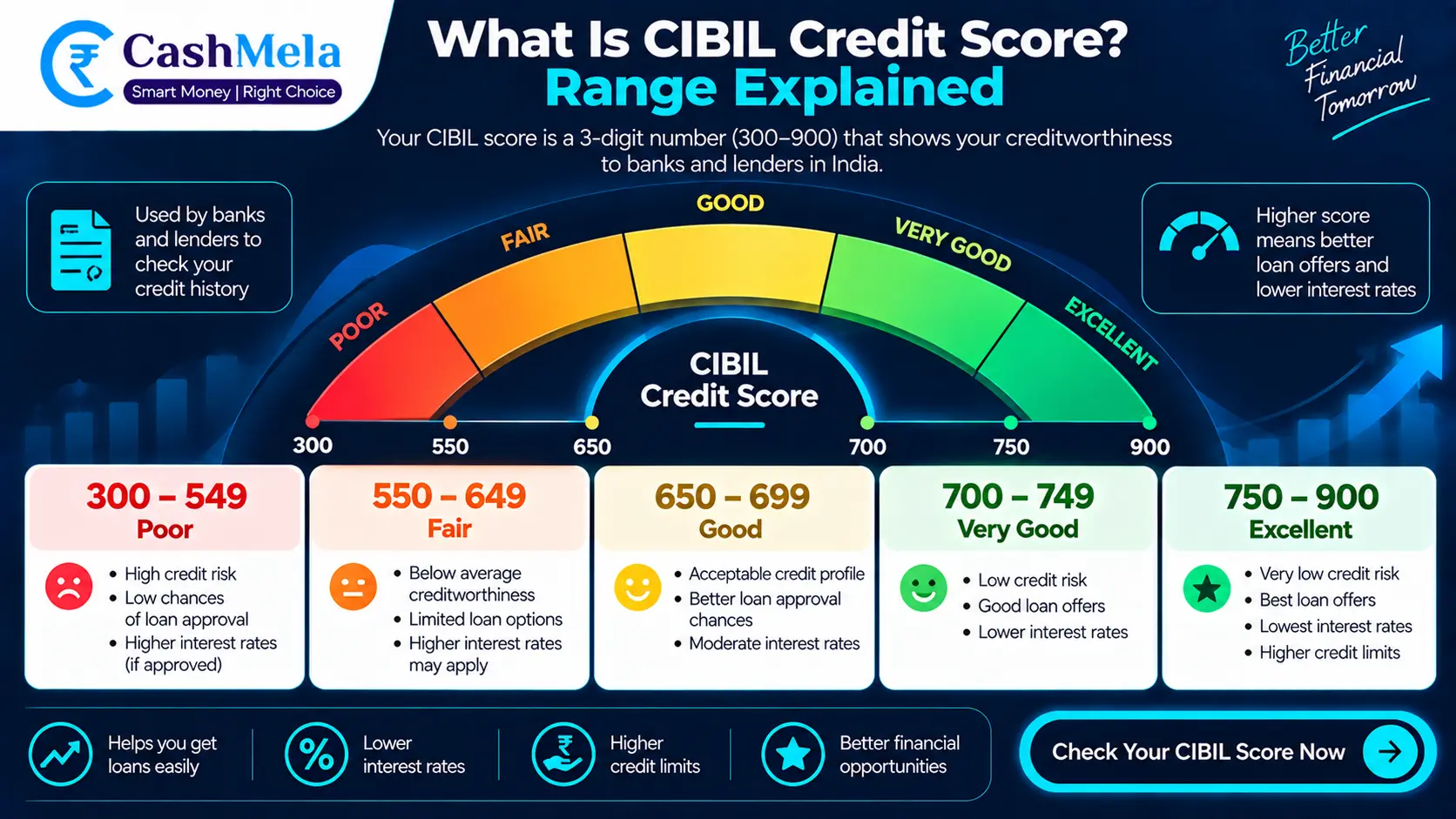
Put simply, your CIBIL credit score is a number between 300 and 900. TransUnion CIBIL, which operates as one of India's four RBI-authorised credit bureaus, arrives at this number by processing the repayment data that banks and lenders routinely submit.
A higher number tells any lender who pulls your file that you're a lower-risk borrower. A lower number tells the opposite story.
Picture your entire borrowing life compressed into one number:
- The personal loan you took out four years ago.
- The credit card you've had since your first job.
- The EMI you paid two days late during a hectic moving month.
- The home loan application where the bank ran a formal check.
Each piece of that history gets factored into the calculation. What is CIBIL credit score, stripped of all the jargon? It's your financial track record made readable at a glance.
The score moves. Lenders report updated account data to the bureau on a monthly cycle, which means the number you see today won't look exactly the same in six weeks. Clear a long-standing credit card balance and that improvement will typically land on your report within a month to a month and a half. Miss an EMI and the same timeline applies, just in the other direction.
What Is CIBIL Credit Score Range and What Each Band Means
Where your score sits within the 300 to 900 range changes what's available to you significantly. Each band carries different implications for approval odds, interest rates, and how quickly a lender will respond.
300 to 549: Poor
Scores at this level usually reflect a history of defaults, repeated late payments, or settled loans that weren't fully repaid. Walking into a mainstream bank with a number in this range will almost always result in a decline. Asset-backed or secured borrowing remains an option since the collateral provides some protection for the lender, but the rates attached are typically punishing.
550 to 649: Fair
Borrowers in this range tend to have an uneven record, periods of responsible repayment interrupted by delays or a default at some point. Some NBFCs and fintech lenders will still approve applications here, though the interest rate on offer tends to be noticeably higher than what's advertised for well-qualified profiles. The silver lining is that this band is also where the score responds relatively quickly to consistent positive behaviour. Three to six months of clean repayment can move someone from fair into good.
650 to 749: Good
Most lenders will engage with this band. Approvals are common, terms are reasonable, and the range of products accessible starts to widen. That said, borrowers in the lower end of this range may find that rates are still a notch higher than advertised. The goal for anyone sitting between 650 and 699 should be pushing past 700 before their next major application.
750 to 799: Very Good
This is where lending conversations shift noticeably in the borrower's favour. Most banks will process applications from this band without additional conditions. Interest rates start approaching the advertised lower end of whatever product is being applied for. Processing timelines also tend to be shorter because fewer manual review steps are triggered.
800 to 900: Excellent
Borrowers here have demonstrated sustained responsible credit behaviour over a meaningful period. They typically receive the most competitive rates, the fastest approvals, and occasionally pre-approved offers from lenders without even having applied. Getting to this band and staying there is a long-term project, not something achieved in a few months.
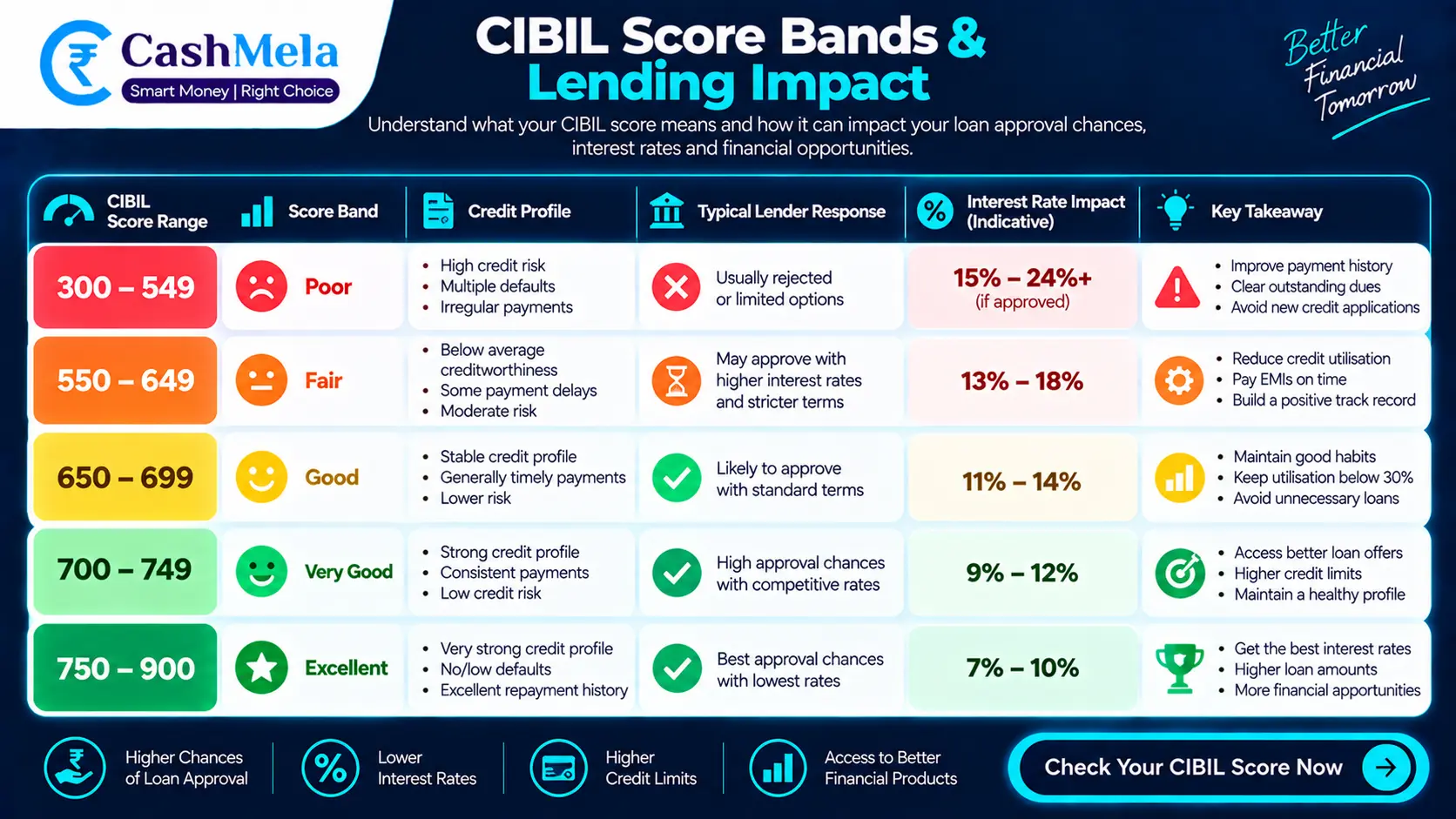
CIBIL Score Bands & Lending Impact Overview
| CIBIL Score Range | Score Band | Credit Profile | Typical Lender Response | Indicative Interest Rate |
|---|---|---|---|---|
| 300 – 549 | Poor | High credit risk, multiple defaults | Usually rejected or limited options | 15% – 24%+ (if approved) |
| 550 – 649 | Fair | Below average, occasional payment delays | May approve with stricter terms | 13% – 18% |
| 650 – 749 | Good | Stable credit profile, generally timely dues | Likely to approve with standard terms | 11% – 14% |
| 750 – 799 | Very Good | Strong credit profile, low credit risk | High approval chances with competitive rates | 9% – 12% |
| 800 – 900 | Excellent | Exceptional repayment track record | Best approval chances with lowest rates | 7% – 10% |
What Is CIBIL Credit Score Made Of: The Five Factors Behind the Number
Understanding what is CIBIL credit score in terms of its actual components helps you know where to focus your energy.
1. Payment History (35% Weight)
This is the dominant factor, carrying roughly 35 percent of the total weight. Every time you paid an EMI on schedule, it strengthened this part of your profile. Every missed payment, delayed credit card bill, or bounced auto-debit worked against it. Payment history is the part of the score most directly in your control, and also the part that takes the longest to repair once damaged.
2. Credit Utilisation (30% Weight)
This measures how much of your available credit card limit you're actively using. Run up ₹ 80,000 of a ₹ 1 lakh limit consistently every month and your utilisation rate is 80 percent. That's considered high and signals financial pressure even when payments are technically being made. Keeping utilisation comfortably under 30 percent is what most scoring models reward.
3. Age of Credit Accounts (15% Weight)
Credit history length is a factor that borrowers consistently undervalue when thinking about what is CIBIL credit score. An account that has been open and performing well for a decade gives lenders far more insight into your behaviour than one that's been active for eighteen months. The longer the record, the more confidence a lender can place in it. This is also why shutting down an old credit card, particularly one with no annual fee attached, tends to work against you. The moment that account closes, its history stops contributing to your active profile.
4. Credit Mix (10% Weight)
Holding a mix of credit types—a home loan or vehicle loan running alongside a credit card and a personal loan—reflects better in the score than holding only one category. It suggests you can manage different financial obligations at the same time, which lenders find reassuring.
5. Recent Credit Inquiries (10% Weight)
Each formal loan or credit card application you submit triggers a hard inquiry on your credit report. One or two in a year is unremarkable. Several in quick succession raises a flag, because it can indicate someone urgently seeking credit from multiple sources at once. Space your applications out wherever possible.
Common Mistakes That Hurt Your CIBIL Credit Score Without You Realising
Meena had a score of 720 and was reasonably satisfied with it. Over the next eight months she closed two old credit cards she never used, applied to four lenders simultaneously while comparing home loan rates, and let a small credit card balance roll over for three months because the amount felt too minor to bother with.
When she checked her score again it had dropped to 668. Each of those three decisions made sense to her individually. Together they cost her 52 points.
Here are the moves that quietly damage scores more often than people realise:
- Closing old credit cards to "simplify" finances: Shortens average credit history and increases utilization overnight.
- Applying to multiple lenders simultaneously: Triggers multiple hard inquiries rather than comparing through soft-check platforms first.
- Treating small credit card balances as too minor to clear: Unpaid balances accumulate late marks and interest penalties.
- Co-signing loans without monitoring payments: Any default or late EMI by the primary borrower directly impacts your score.
- Ignoring credit report errors: Disputing errors promptly is critical to prevent incorrect late marks from lingering.
None of these are dramatic financial mistakes. But each one has a measurable effect on the number and understanding what is CIBIL credit score means understanding that small decisions accumulate in both directions.
How to Build and Protect a Strong CIBIL Credit Score
Once you understand what is CIBIL credit score and how it moves, the path to a better number becomes clearer:
- Pay before the due date, not on it: Processing delays can occasionally push a payment past the reporting cutoff even when it was made on the due date. Building a one to two day buffer eliminates that risk entirely.
- Check your report at least once a quarter: Errors appear more often than most people expect. Accounts marked open after being repaid, overdue tags on cleared balances, inquiries from lenders you never approached. Each of these can be disputed through the TransUnion CIBIL portal and removed if the error is confirmed. Correcting a single genuine error can shift a score by thirty to sixty points in some cases.
- Use credit cards regularly but keep balances low: A credit card that sits unused for too long may eventually be deactivated by the issuer. Use it for one or two small recurring purchases each month and pay the balance in full. This keeps the account active, builds payment history, and keeps utilisation low at the same time.
- Avoid applying for new credit unless there's a real need: Pre-approved offers, EMI options at checkout, new card sign-ups at retail stores: every one of these triggers an inquiry and adds a new account to your profile. Both have short-term effects on the score. Be deliberate about when and why you add new credit to your file.

Frequently Asked Questions
Q1: What is CIBIL credit score and who calculates it?
A: CIBIL credit score is a three-digit number between 300 and 900 that reflects your creditworthiness based on your borrowing and repayment history. It is calculated by TransUnion CIBIL, one of four credit bureaus authorised by the Reserve Bank of India to collect and maintain credit data on individuals and businesses.
Q2: What is a good CIBIL credit score for a loan application?
A: 750 and above is widely considered the benchmark for competitive loan approvals in India. At this level, most lenders process applications without additional conditions and offer rates near their advertised best. Scores between 700 and 749 are generally acceptable but may attract marginally higher rates. Below 650, options narrow and rates increase accordingly.
Q3: How often does my CIBIL credit score update?
A: Your score updates as lenders submit fresh data to the bureau, which typically happens on a monthly cycle. A change in your financial behaviour today, such as paying off a balance or missing a payment, will generally reflect in your score within thirty to forty-five days.
Q4: Can I check what is CIBIL credit score for free?
A: Yes. TransUnion CIBIL provides one free credit report per year to every individual under RBI guidelines. Many bank apps and financial platforms like CashMela also offer free score checks with no frequency restrictions. Checking your own score never affects the number.
Q5: What is the difference between CIBIL score and credit score?
A: In common usage in India, the terms are often used interchangeably. Technically, a credit score can be issued by any of the four licensed bureaus: TransUnion CIBIL, Experian, Equifax, and CRIF High Mark. A CIBIL score specifically refers to the score issued by TransUnion CIBIL, which is the most widely referenced bureau by Indian lenders.
Q6: What is CIBIL credit score for someone with no credit history?
A: If you have never taken a loan or held a credit card, your profile will show NH (No History) or NA (Not Applicable) instead of a numerical score. This is not a negative rating, but it does mean lenders have no data to assess you on. Starting with a secured credit card and repaying it consistently over six to twelve months is the standard way to build a scoreable history.
Q7: How long does it take to improve a low CIBIL credit score?
A: It depends on why the score is low. If the cause is high credit card utilisation, bringing balances down can produce visible improvement within one to two billing cycles. If the cause is a history of missed payments or defaults, improvement takes longer because those entries remain on the report for up to seven years, though their impact does diminish as positive recent history builds up around them. Realistically, moving from a poor score to a good one takes six to twelve months of consistent responsible behaviour.
Conclusion
Understanding what is CIBIL credit score isn't just useful when you're applying for a loan. It's useful every time you make a decision that touches your credit file, whether that's choosing whether to close an old card, deciding how many lenders to approach at once, or figuring out how to handle a tight month without letting something slip past its due date.
The score is always in motion, always reflecting the sum of recent decisions. Knowing what is CIBIL credit score means you're no longer flying blind on one of the most consequential numbers in your financial life.
Ready to see where your score stands today? Check your CIBIL score free on CashMela and explore personalised loan offers across 40+ lenders with no impact on your credit report.
Explore Related Financial Guides:
- 📊 Free CIBIL Credit Score Check Guide
- 💳 How to Improve My CIBIL Credit Score: 90-Day Plan
- 💰 Compare Personal Loans from 40+ Lenders
- 🏢 MSME & Business Loan Interest Rate Guide
- 🧮 Free Personal Loan EMI Calculator
- 🔄 Debt Consolidation Strategy Guide
Stay Informed, Stay Ahead!
Follow Cashmela on social media for more practical finance guides, loan tips, and the latest updates:
- 💰 Instagram: @cashmela_com – Simple finance tips and real borrower stories
- 👍 Facebook: Cashmela – Join the conversation and never miss an update
- 🐦 X (Twitter): @cash_mela – Quick updates and finance news
- 💼 LinkedIn: Cashmela – Industry insights and company updates
✨ Let's make smarter borrowing simple, together!
Disclaimer: Credit score information, eligibility criteria, and loan terms mentioned in this article are indicative and subject to change. Please verify the latest information with TransUnion CIBIL or your chosen lender before making any financial decision. This article is for informational purposes only and does not constitute financial advice.

Samarth Shigvan
Marketing Head & Growth LeadAuthor & Financial Analyst at CashMela.com
Samarth Shigvan is the Marketing Head at Cashmela.com. He oversees brand strategy, performance marketing, SEO, and borrower educational initiatives across India. Samarth is passionate about simplifying complex financial topics—such as CIBIL score optimization, interest rates comparison, and debt freedom strategies—into actionable, transparent guides for everyday consumers.