Introduction
Rahul and his colleague Deepak both applied for personal loans the same week at the same bank. Same city, similar salaries, same employer. Rahul got approved at 11.5 percent. Deepak got approved too, but at 15.8 percent.
The difference came down to one thing: their CIBIL scores. Rahul's was 778. Deepak's was 691.
Neither of them had thought much about credit scores until that moment, but Deepak's higher rate translated into paying roughly ₹ 42,000 more over a three-year tenure. Knowing what is a good CIBIL credit score, and actively working toward it, is the kind of financial habit that pays in actual rupees.
What Is a Good CIBIL Credit Score: The Number That Actually Matters
Ask ten people what is a good CIBIL credit score and most will say 750. They're not wrong, but the fuller answer is more useful than a single threshold.
Lenders in India don't operate on a single universal cutoff. Each bank and NBFC has its own internal scoring model that weights different factors differently. A score of 740 might sail through at one lender and face additional scrutiny at another.
That said, 750 is the number that appears consistently across lender guidelines and eligibility pages as the point where most products become accessible at their best terms.
How Lenders Interpret Each Score Bracket
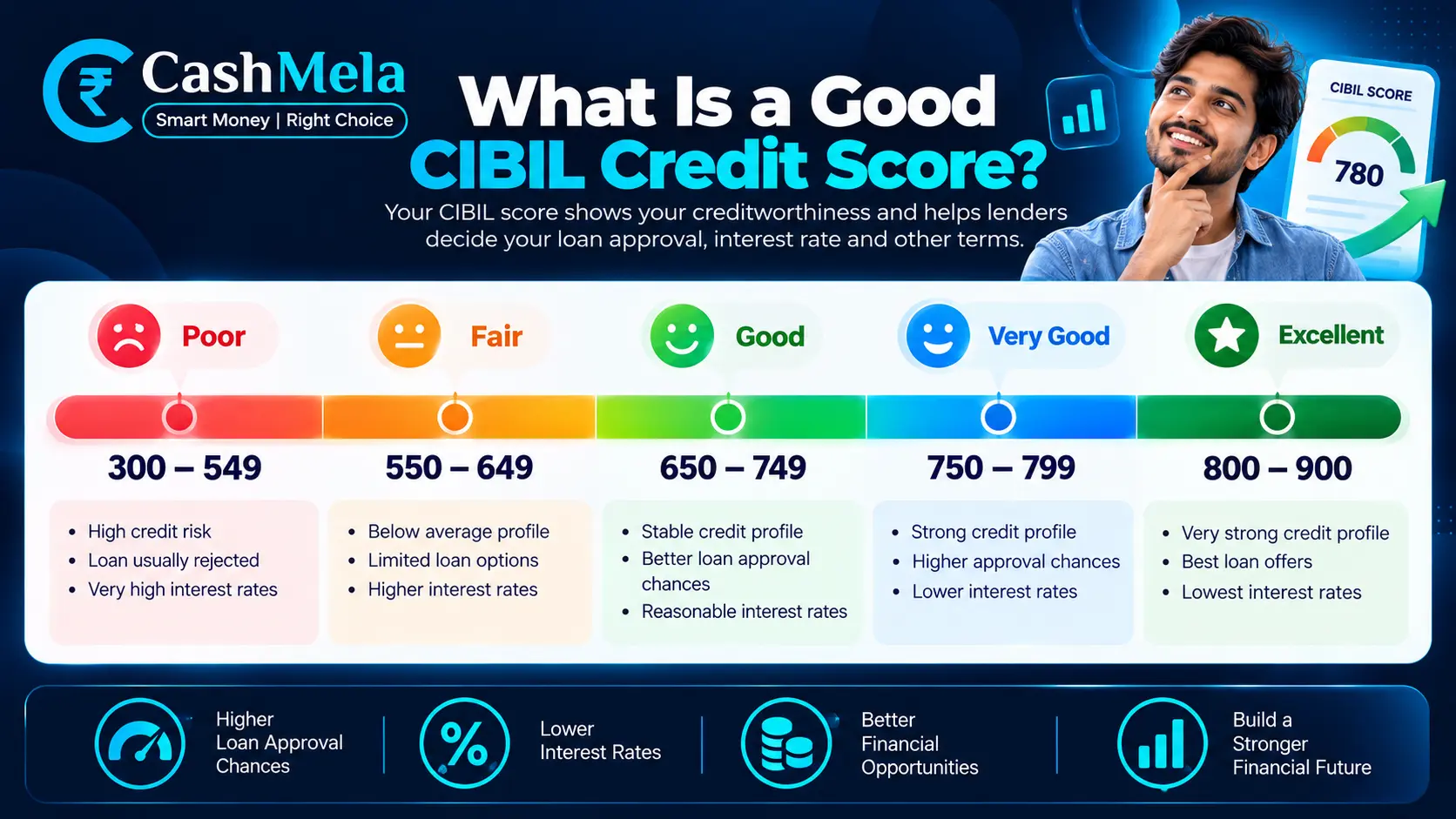
| Score Band | CIBIL Range | Borrowing Standing | Typical Lender Response |
|---|---|---|---|
| Poor | 300 – 549 | Critical Risk | Mainstream rejection; only punishing secured options |
| Fair | 550 – 649 | High Risk | Select NBFCs/fintechs with high interest premiums |
| Good | 650 – 749 | Moderate Risk | Broad approval odds; rates slightly above lowest tier |
| Very Good | 750 – 799 | Low Risk | Prime lending terms, rapid paperless turnaround |
| Excellent | 800 – 900 | Elite Standing | Lowest market interest rates & pre-approved perks |
Here's a more practical way to think about the range:
- 750 and above: Puts you in the strongest borrowing position. Applications move faster, rate offers land nearer to a lender's best price, and fewer conditions get attached to the approval.
- 700 to 749: Works at most lenders, but expect to see a rate that's slightly higher than the headline figure that drew you in. You're close, but there's a real cost to being on this side of 750.
- 650 to 699: This is where approvals become conditional. NBFCs may still engage, but the loan amount offered could be lower than requested, the tenure shorter, and the rate clearly higher.
- Below 650: The mainstream unsecured market largely closes off. Collateral-backed products remain available, but the pricing reflects the risk the lender is absorbing.
Practically speaking, what is a good CIBIL credit score is the number above which borrowing stops quietly costing you more than it should.
What Is a Good CIBIL Credit Score for Different Loan Types
The answer shifts depending on what you're applying for. Different products carry different risk profiles, and lenders price that into their minimum requirements.
Personal Loans
Because personal loans carry no collateral, the lender's only protection is your credit profile. Banks respond to that by setting higher score expectations. A score of 750 and above is where what is a good CIBIL credit score translates into genuine personal loan advantages: more lenders to choose from, rates that don't quietly punish you for being slightly below the threshold. NBFCs will engage from around 680 upwards, but the gap in rates between 680 and 750 is wide enough to matter over a three or four year tenure.
Home Loans
Home loans sit in a different risk category because the property itself acts as security. That gives lenders a bit more room to consider applications from 700 upwards. However, the rate impact across the 300 to 900 range on a home loan is substantial. Run the numbers on a ₹ 50 lakh loan over twenty years and the difference between a score of 720 and one of 800 can easily add up to six figures in additional interest paid. For home loans as much as any other product, what is a good CIBIL credit score worth chasing is still 750 and above.
Business Loans
Business loan assessments combine your personal score with your company's financial statements, GST history, and banking behaviour. On the personal score side, most lenders set their floor for unsecured business lending somewhere between 700 and 720. Clear 750 and the conversation shifts: better pricing, quicker decisions, and fewer documents asked for during underwriting.
Credit Cards
Premium credit cards with high limits and good rewards programmes generally want to see scores of 750 and above. Basic credit cards are accessible from around 650 onwards. The card category you qualify for directly affects the limit you're offered and the benefits attached.
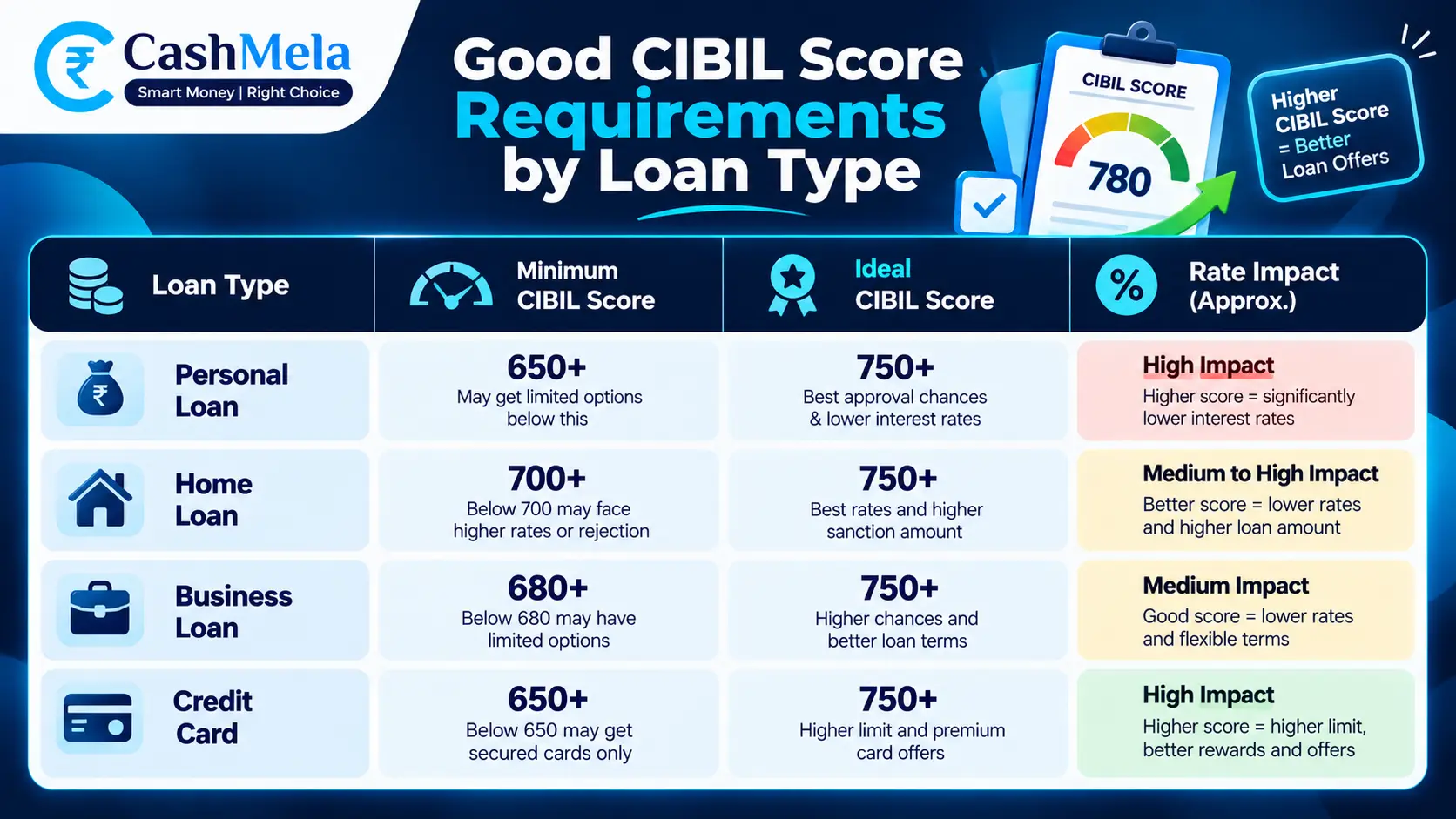
Good CIBIL Score Requirements by Loan Type
| Loan Type | Minimum CIBIL Score | Ideal CIBIL Score | Rate Impact (Approx.) | Key Lender Advantage |
|---|---|---|---|---|
| Personal Loan | 650+ (Limited options below this) | 750+ | High Impact (Significantly lower interest rates) | Wider lender choice & fast approvals |
| Home Loan | 700+ (Below 700 risks rejection) | 750+ | Medium to High Impact (Saves lakhs in interest) | Max loan sanction & best floating rates |
| Business Loan | 680+ (Below 680 requires collateral) | 750+ | Medium Impact (Lower rates & flexible terms) | Unsecured working capital & faster disbursal |
| Credit Card | 650+ (Secured cards below this) | 750+ | High Impact (Premium tier rewards & higher limit) | Pre-approved credit limit enhancements |
Five Things That Determine Whether Your Score Is Good or Not
Knowing the target number is the easy part. Knowing which levers actually move you toward it is where most borrowers need more detail. Five factors feed into the calculation, and they carry different amounts of weight:
1. How Reliably You Pay (35% Weight)
Your repayment track record carries more weight than any other single factor, contributing close to 35 percent of the total score. Each month you pay every EMI and credit card bill before it's due, that part of your profile grows stronger. The flip side is that missed payments are the slowest thing to repair. Negative payment marks sit on the report for years, and their drag on the score only dilutes gradually as positive recent history accumulates around them.
2. How Much of Your Credit Limit You Use (30% Weight)
Utilisation is calculated by dividing your current credit card balances by your total available limit across all cards. Routinely carrying 70 or 80 percent of that limit as outstanding balance sends a signal of financial strain to the scoring model, even when payments are being made on time. Dropping utilisation to under 30 percent changes that reading noticeably. Under 20 percent is where the score formula responds most positively.
3. How Long Your Accounts Have Been Active (15% Weight)
A borrower whose oldest credit account is twelve years old has a longer track record than someone whose oldest account is two years old. Credit history length rewards patience. It's also why closing old credit cards, even ones you barely use, tends to work against you.
4. The Variety of Credit You Carry (10% Weight)
A mix of secured and unsecured credit—a home loan or vehicle loan alongside a personal loan and a credit card—scores better than a profile with only one type of product. It shows you can manage different kinds of financial obligations without dropping the ball on any of them.
5. How Recently You've Applied for New Credit (10% Weight)
Every formal loan or credit card application triggers a hard inquiry on your file. A cluster of applications in a short window raises questions about financial stability, even if each application was just comparison shopping. Use soft-check platforms like CashMela to compare offers before committing to a formal application anywhere.
Habits That Slowly Push Your Score Into Good Territory
Getting to a point where you're genuinely above 750 doesn't require dramatic gestures. It requires boring consistency over time.
Nisha had a score of 698 when she first checked it. Rather than applying for the loan she needed immediately, she spent five months doing four specific things: she stopped letting her credit card balance roll over month to month, she set up auto-pay on every EMI, she left her two old credit cards open instead of closing them, and she didn't apply for any new credit during that period.
When she checked again her score had moved to 741. Not perfect, but enough to move her into a better rate bracket when she finally applied. The loan cost her less than it would have five months earlier.
4 Actionable Habits to Start Today:
- Pay a few days before the due date, not on it: Banks have reporting cutoffs that don't always align with your due date. Paying two to three days early removes any risk of a payment appearing late in the data CIBIL receives.
- Bring down revolving balances before the billing cycle closes: Credit card utilisation is calculated at the point of each monthly report. Paying down a balance before the billing date closes is more effective than paying after, because the lower balance is what gets reported.
- Dispute errors without putting it off: Errors on credit reports are genuinely common. An account that shows as overdue after you've settled it, a loan appearing open when it was repaid, an inquiry from a lender you never approached. Each of these pulls your score down for no reason. The TransUnion CIBIL portal has a dispute resolution process and resolved errors can produce real score movement.
- Stop applying for credit you don't need: Retail store credit cards, easy EMI schemes at checkout, new cards because the sign-up bonus looks attractive. Every one of these is a hard inquiry and a new account. Both affect your score in the short term. Be selective.

Frequently Asked Questions
Q1: What is a good CIBIL credit score for getting a loan in India?
A: For most unsecured loans like personal loans and business loans, 750 and above is considered a good CIBIL credit score. It gives you access to the widest range of lenders and rates closest to the advertised best. For secured loans like home loans, some lenders will approve from 700 onwards, though you'll get better terms at 750 plus.
Q2: Can I get a loan with a score below 700?
A: Yes, but your options narrow and the rates go up. NBFCs and digital lenders tend to be more flexible than traditional banks, particularly for scores between 650 and 699. Secured loans are also more accessible at lower score levels. That said, if your need isn't urgent, spending a few months improving your score first is almost always the cheaper path.
Q3: How long does it take to reach a good CIBIL credit score?
A: It depends entirely on your starting point and what's dragging the score down. Someone at 700 who addresses utilisation and sets up auto-pay could reach 750 within three to six months. Someone recovering from defaults or a debt settlement may take twelve to eighteen months of consistent clean behaviour before getting there.
Q4: Does checking my score affect it?
A: No. Checking your own score through CashMela, your bank's app, or the TransUnion CIBIL website is a soft inquiry and has zero effect on your number. Only a hard inquiry, which happens when a lender formally pulls your report during a loan application, affects the score.
Q5: Is 750 actually what is a good CIBIL credit score or is it just a myth?
A: It's not a myth, but it's also not an absolute threshold. 750 is the level where most lenders in India consistently offer their best terms and fastest processing. Below that, you're still approvable at many lenders, but the rate environment gets progressively less favourable the further you go. 750 is a genuinely meaningful target.
Q6: What pulls a good score down quickly?
A: Missing even one EMI payment, letting credit card utilisation spike above 70 or 80 percent for a billing cycle, closing old accounts that were in good standing, or submitting multiple loan applications within a short period. Any one of these can move a score downward noticeably. All of them together can drop a good score into fair territory within a few months.
Q7: Can I reach 800 and above?
A: Yes, and it's worth aiming for. Scores above 800 open up the most competitive products, the lowest rates, and in some cases pre-approved offers that arrive without you having applied at all. Getting there requires sustained responsible credit behaviour across multiple years, not just a few months. But it compounds: the longer a clean record runs, the more it reinforces the score.
Conclusion
The question of what is a good CIBIL credit score has a clear practical answer: 750 and above is where borrowing becomes noticeably cheaper and smoother. But the more useful question is what you're doing right now that's either building toward that number or quietly working against it.
The habits that produce a good score aren't complicated. Pay on time, keep balances low, leave old accounts open, and don't apply for credit you don't need. Done consistently, those four things account for the majority of what makes what is a good CIBIL credit score achievable for almost anyone.
Ready to see exactly where your score stands today? Check your score free on CashMela and compare personalised loan offers across 40+ lenders with no impact on your credit report.
Explore Related Financial Guides:
- 📊 Free CIBIL Credit Score Check Guide
- 📖 What Is CIBIL Credit Score: Complete Beginner Guide
- 📈 How to Improve CIBIL Credit Score: 90-Day Plan
- 💰 Compare Personal Loans from 40+ Lenders
- 🧮 Free Personal Loan EMI Calculator
- 🔄 Debt Consolidation Strategy Guide
Stay Informed, Stay Ahead!
Follow Cashmela on social media for more practical finance guides, loan tips, and the latest updates:
- 💰 Instagram: @cashmela_com – Simple finance tips and real borrower stories
- 👍 Facebook: Cashmela – Join the conversation and never miss an update
- 🐦 X (Twitter): @cash_mela – Quick updates and finance news
- 💼 LinkedIn: Cashmela – Industry insights and company updates
✨ Let's make smarter borrowing simple, together!
Disclaimer: Credit score information, eligibility criteria, and loan terms mentioned in this article are indicative and subject to change. Please verify the latest information with TransUnion CIBIL or your chosen lender before making any financial decision. This article is for informational purposes only and does not constitute financial advice.

Ayyaz Patel
Co-Founder & Chief Operating OfficerAuthor & Financial Analyst at CashMela.com
Ayyaz Patel is the Co-Founder and COO of Cashmela.com. He leads strategic operations, lender integration, and customer success journeys across Tier-1, Tier-2, and Tier-3 cities in India. Ayyaz's operational blueprint has streamlined the e-KYC and digital verification turnaround time to under 4 hours, ensuring seamless, zero-friction loan application experiences for thousands of daily users.